Monday, January 2, 2012

2011 A Year in Books: Idea Texts

This year I split my year end book post into idea books (this post) and narrative or story (previous posts).

Here is the key to the shorthand notes:

(A) - Audio – I listened to this book
(N) – I have a word document of notes and quotes from this book[1]
(!) – I really liked this book
(X%) – I didn’t finish this book – I either ran out of time to comit or felt like I got the gist - this is the percentage I read

I went overboard with the footnotes (even for me) – feel free to skip them, but if they interest you, you might want to open a second browser.


Fear and Trembling[2] - Soren Kierkegaard (50%) (!)(N)

“There were countless generations who knew the story of Abraham by heart, work for word, but how many did it render sleepless” [3]

I was scheduled to preach on Abraham sacrificing Isaac this year before I gave the passage away to my friend Zach. But while I was still planning to do the talk, I revisited my favorite work on the story. SK is my favorite philosopher.[4] I wrote six papers on him during my theology degree, including one on F&T. Unsurprisingly, I found that I had not understood it at all my first time through.[5] But it was fun to revisit an old friend…especially one this playful. I remember back when I was doing my Kierkegaard independent study I told my brother ‘I just read about a thousand pages of Kierkegaard.’ His response was apt; “That sounds good for the soul.”

Not The Way It’s Supposed to Be[7]: A Breviary of Sin - Cornelius Plantinga[8] (!) (N)

“Like some mad charioteer, we now run our lives with more speed than direction.” [9]

I started this book seven years ago, found the first chapter underwhelming, and set it aside. When I picked it up this summer it still had the Olympic National Park bookmark in it, from my first attempt during a pre-kids hiking trip. But it just kept popping up as a substantial influence in books I love by writers I respect. So I picked it up again…and I came to believe that in addition to the explicit references to this work that had prevailed on me to read it, there was a whole body of insight transferred to me uncited by secondary sources, that had its origin in this work. It was breathtaking.

It is a thin work (200 pages) dense with insight. However, unlike Volf (below) this little book yielded its value effortlessly. Plantinga writes engaging, clear, precise, fluid, enjoyable prose [10] and has a knack for fresh language that breathes new life and imaginative energy into tired ideas. [11]

Plantinga’s strength is semantic precision and careful distinction. He takes a clumsy, shadowy concept like ‘sin’ and identifies its constituent parts. [12] Additionally, since he is a psychologist first and theologian second, he makes helpful attempts to ask integrating questions (e.g. what connection is there between addition and sin) and comes away with believably nuanced answers. Really, just a great little book.

Key Thinkers in the Sociology of Religion - Richard Fenn

"the resurgence of conservative religion...taken together provide a massive falsification of the idea that modernization and secularization are cognate phenomena." Fenn (on Berger)

Every year I try to take on an experimental reading program. Consider it the ‘high volatility’ portion of my ‘reading portfolio.’ For years I have wanted to dive into the literature on the Sociology of Religion, but didn’t know where to start. Fenn’s book was like sending a scouting party in a realm of unknown and promising reflection. Like Joshua and Caleb reporting back from Canaan, Fenn gave a report of a realm guarded by the imposing, troubling, giants (Freud and Weber) but that it was a land of rich reflective resources (Martin and Burger) that made it worth forging deeper.


A Far Glory: The Quest for Faith in an Age of Credulity (!) (N) – Peter Berger

“Hopelessness does not have a superior epistemological status.” [13]

This was my most influential book of 2011. I am officially a PB fanboy. I guarantee that future lists will include more. Over the summer I ran overnight flume experiments and passed the late hours easily reading this book. Burger poses a number of startling and fertile ideas regarding how human communities influence individual beliefs. He is most famous for coining ‘plausibility structures’ [14] and ‘the sacred canopy’ and for paradigm shifting work on the causes and influences of secularization. But one of the refreshing things about Berger is that he recognizes that these social components of belief are not somehow limited to religious worldviews and recognizes that ‘intellectuals’ are not somehow magically exempt. [15] He finds the work of plausibility structures and social warrants for belief in most modern worldviews and takes the ubiquitous sociological data of the human experience of transcendence seriously.

AFG included a number of helpful ideas that really deserve their own posts but include:
  • ‘belief clusters’
  • mysticism’s ‘morning after’ problem
  • the role of institutions (religious and secular) as metaphysical ‘beasts of burden’
  • the rise of the knowledge class which led to a split in the middle class and set up our current political landscape, and
  • the possibility that secularization has not, in fact, been a story of progress but, just maybe, it is a story of ‘epistemological deprivation.’ [16]

“It is quite possible that in the dawn of its history the human race had an access to reality that it subsequently lost, as it is possible that this reality is briefly accessible in childhood and then lost in the basically depressing process of growing up. If so, what we commonly think of as progress may actually be a devastating story of epistemological deprivation.”


Miller is a Christian professor of Molecular Biology (Brown) that travels around debating creationists and famous proponents of intelligent design. [17] He is often mentioned in the same breath with Francis Collins of Orthodox believers with scientific street cred who reject ID and defend the neo-Darwiniain synthesis.


The book is OK. He effectively deconstructs the ID arguments but in his efforts to distance himself from the ID community, he is often uncharitable. [18] But he is a capable author and the last couple chapters where he describes his own scientific-theological synthesis are quite good. He argues that because of the unexpected weirdness of modern physics it is far easier to be a Christian today than it was 100 years ago. [19]

  
The Goldilocks Enigma – Paul Davies (50%) (!)


“Somehow the universe has engineered not just its own awareness, but its own comprehension. Mindless blundering atoms have conspired to make, not just life, not just mind, but understanding. The evolving cosmos has spawned beings who are able not merely to watch the show but to unravel the plot. What is it that enables something a small and delicate and adapted to terrestrial life as the human brain to engage with the totality of the cosmos and the silent mathematical tune to which it dances?”


Davis is a cosmologist at the University of Arizona and is an affable and complicated figure. I read this book to help craft my ‘positive arguments’ lecture for our Apologetics class. It is the current, definitive lay treatment of the fine tuning argument. The book surveys some of the findings of contemporary physics and asks the old teleological question in its updated, more precise, form…Is chance really the best explanation for all this? “Like the porridge in the tale of Goldilocks and the three bears, the universe seems to be ‘just right’ for life in many intriguing ways.”
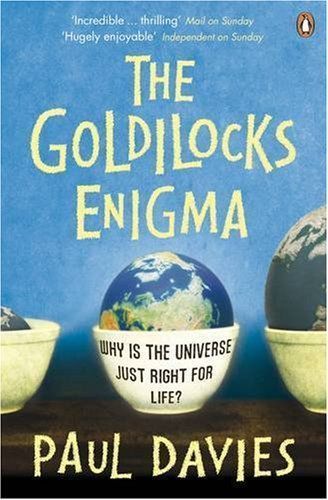
It is much more a science text than a theology text, but it is accessible, readable and compelling.


Love Wins – Rob Bell

I hate being forced to read a book. So if a marketing blitz makes a book so talked about that I am forced to read it because people want my take on it, I am generally not a sympathetic reader. Reading time is one of my most precious and limited commodities and this author has essentially stolen it from me with clever marketing. Previous offenders include the Da Vinci Code and Left Behind.

Love Wins is not a very good book (though it is not nearly as bad as the other two I just mentioned). [20] Bells’ characteristic, playful, subversive, staccato, conversational style (which, generally, is impossible not to enjoy) does not lend itself to a weighty work of theology. You cannot write a systematic work of theology in 6 word sentences or with a book that is mostly white space. And there are a couple of unfortunate pages where he flirts [21] with a modest form of universalism. [22]

But, these things do not rank as the thing I liked least about this book. What I liked least was the plagiarism. You see, each chapter was essentially a book report (in Bell’s characteristic style) on a text I have read and found influential. First, we get the argument from Wright’s Surprised by Hope, then Keller’s Prodigal God, then Stott’s The Cross of Christ. There is little attempt at synthesis with other authors, the arguments are essentially lifted from these books and put in Rob’s voice. But this simply makes the text unoriginal. The thing that bothered me was that none of these authors were credited [23] for their ideas and only two of the three [24] were included in the ‘for further reading’ list at the end of the book. That is not ok…especially given the kind of money this book made.


With all that said, most of the discussion of this book has been far to earnest (bordering on hyperbolic)…and in contrast, Don Miller wrote my favorite piece on this little book.

Genesis For Everyone Part 1 and Part 2 - Goldengay (!)

“Abraham is a hero on Monday, Wednesday and Friday and a wimp on Saturday, Tuesday and Thursday. Today it’s Tuesday.”


I like Goldengay. Sure he might attribute more creative effort to the Babylonian editor than I do. And from time to time he might be a block or two left of me. [24] But his insights are penetrating, his prose is effortless to read, and his personal story [25] (which he weaves into these ‘for everyone’ volumes) gives him credibility.

Genesis NIV Application Commentary [26] - Walton (50%)


It is kind of funny that I only read this commentary through Genesis 3, and still read half of it. Walton’s background and commentary on the first three chapters is a long as his commentary on chapters 4-50. [27] But he is great. Walton’s analysis is characterized by two distinctive qualities:

  
1) Hermeneutical precession: Walton was explicit with his hermeneutics as he undertook the tasks of difficult interpretation in a way I rarely see in commentaries. In some ways, this text doubles as a hermeneutics text by practical and repeated case study. Whenever he encountered controversy, he identified the ‘resistant communication’, examined the semantic range, and brought the synchronic and diachronic evidence to bear (placing the priority on the former).

  
2) Comprehensive Understanding of the Ancient Mesopotamian[28] Milieu. Walton has a comprehensive mental map of the other stories and civilizations that the Genesis narrative was written into. He employs similarity and dissimilarity as interpretive aids rather than tools for genetic speculation and leverages them to cast light on difficult passages. [29]

  
Genesis Walter Brueggemann/Derek Kidner [30] (20%)

   
I usually try to read 4 commentaries on any passage I preach. [31] One to the right, one to the left and a couple more in my theological neighborhood. In this metaphor, Kidner basically lives in my house. His commentary is incredible because he generally has one or two pages of fragments per passage, but without fail, they have been outstanding. Brueggemann was the commentary ‘on the left.’ I have a complicated relationship with Brueggemann. Sometimes his exegesis is unmatched in its weight and insight. And sometimes it is just goofy. No one had more useful insight on the Tower of Babel but his Genesis 3 analysis made me wonder if we were reading the same text.


Exclusion and Embrace – Miroslov Volf (N) (!)


“Instead of simply affirming plurality we must nurture an awareness of our own fallibility…a world neatly divided into territories of pure light and of utter darkness…exists (only) in the imaginations of the self-righteous…In a world shot through with injustice, the struggle for justice must be carried on by people inescapably tainted by injustice.”

“Perception is a moral exercise.” [32]

  
Great book. Volf is Serbian and refreshingly unaffected by the ‘pleasant trappings of the western suburban sensibility’ that dominates most of our flaccid and stunted discourse about justice, power, and reconciliation. He has a fierce mind and a humble posture. He interacts effortlessly (and often sympathetically [33]) with Foucault and Macintyre but rests unapologetically on Jesus and the Christian story. He is not cowed by intellectual bullies [34] but sympathetic to de-centered voices. [35] E&E was difficult reading but productive reflection.

Ecological Restoration: Principles, Values, and Structure of an Emerging Profession - Various

Maybe restoration isn’t something you can learn from a text book. At several universities the river restoration research is happening in studio based departments like Landscape Architecture. But I found this text pretty unhelpful. We read a couple chapters and two student assigned papers each week as part of a discussion based class in Restoration Ecology. The papers were, without exception, more valuable. And this is probably why there are not more ecology texts on this list even though I am an currently an Ecology grad student. Once you progress from the introductory synthesis to the actual messy details, debates and paradoxes of a field, the primary literature is where it is at. Most of my professional and academic reading this year was dedicated to journals.


Mere Discipleship – Lee Camp

“We might summarize Revelation this way: in the ring of human history there's a bleeding lamb in one corner and a dragon in the other. 'Common sense' would tell us we should place our bet on the dragon-but there is a new common sense, a new reality, in which the Lamb runs out victorious."


Sometimes it matters when you read a book. If I had read this book a decade ago it would have been paradigm shifting. But on the other side of ‘the new social gospel’ I had a better understanding of the truth and over-simplification involved in the neo-Anabaptist thing. I hugely appreciate the attempt to deconstruct the western evangelical allergy too suffering and our ‘Constantinian’ desire to intertwine church and state…but find something similarly sub-Christian about the moralistic tone and implicit salvation-through-suffering soteriology.


Learning Theology with the Church Fathers – Christopher Hall (50%) 


“If I love the wrong things, I will consistently choose the wrong things…an act of choice is not just a matter of knowing what to choose: it is a matter in which loving and feeling are involved. ”


I am a fan of ‘the Fathers’. So I was destined to love this book. It has been on my reading list for a while. I picked it up for a talk I am doing on the historical doctrine of human nature…but could not put it down until I got through the Chrystostom on Providence and Gregory of Nyssa on the Spirit.

Hall is more than an expert of dusty texts, he is a man with dead friends. And he introduces us to them with deep affection and apt admiration. He does the hard work of understanding these men on their terms and delivering them to us as ‘and antidote for theological and ethical faddism’ and argues that due to their ‘hermeneutical proximity’…’they often hear melodies and harmonies in the biblical narrative that modern Christians fail to discern.”

Sex and the Soul – Donna Freitas [36] (N)

  
“Students at (secular public, secular private and Catholic) [37] colleges may have all the sexual freedom in the world, but it is not giving them much reward.”


It was a good year for me and Boston University. This is exactly what I was looking for. A substantive work of social research (published by Oxford press). [38] Freitas surveyed 2,500 students and interviewed 111 to understand the interaction of spirituality and sexuality on the American campus. Then she delivers her systematic findings through an anecdotal narrative structure (recounting the most memorable interviews that articulated the general findings) that made the text highly readable.

 have a post ready to go on this book as part of the 4 to 5 part romance series I am going to run in January (leading up to a talk I am writing on the topic)…so I’ll say more then.


Defining your dating style: 5 paths to the love of your life – Multiple Authors 

“We use the other for our own glorification, we bask in the presence of our beloved because we enjoy the image of ourselves that is reflected back.” - Lauren Winner

  
I pretty much hate dating books. [38.5] For something so shrouded in mystery they are almost uniformly far too dogmatic. I find the dating/courtship debates [39] to be mostly a matter of semantics and have seen both models go catastrophically poorly with approximately the same frequency. So this book was a bit of a refreshing change, offering five different [40] positions and a fair amount of insight. In particular, it was helpful to recognize their areas of agreement and disagreement.

  
There was a 500 pound gorilla in the room, however. The finest writing [41] and reflection in this text was by Lauren Winner, who referenced her new marriage several times in the essay…a marriage which did not last. Just like bigotry in secular culture[42], divorce is the failure the church often does not allow redemption from. You can almost hear the smug response by one or two of her interlocutors to this event that had not yet happened. [43] But here is the thing. Her thoughts are still kind [44] and wise and helpful. And that is the really beautiful thing about the Christian community. Failure does not disqualify.

The Meaning of Marriage – Time Keller (!)  

“single people (need)…a balanced, informed view of marriage…(or) they will either over-desire or under-desire marriage, and either of those ways of thinking will distort their lives.”

After I read this book I sat down and wrote Keller an e-mail to thank him for being my ‘remote mentor’ (thought his MP3’s and books – which is kind of like having an imaginary friend but more profitable) for about 4 years now. This is practically a transcript of a 1992 series he gave on Marriage [45] and has become my new go-to recommendation on the topic (as well as my new go-to wedding present).

From the Front Porch to the Back Seat: A History of Courtship in the US – Beth Bailey

  
Don’t let the fun title, fool you…this is a weighty and scholarly work. It seems as though Bailey has read every singly ‘teen magazine’ and ‘dating manual’ written between 1890 and 1960 and that each paragraph quotes 2-4 of them. [46] But, despite the dense content Baily writes extremely well. [47] Pages fly by as insights and paradigm shifts pile up. I hope to do a post on this book in the next few weeks too, but for not I’ll just say that it was helpful to understand the generational ebb and flow of romantic mores and appreciate the sheer novelty of each system. Anyone who hopes to do substantive thinking on any social phenomenon has to ask, ‘how did we get here.’ Bailey was an able guide to the recent history of dating in our culture.

Previous year’s posts: 2010, 2009

_________________

[1] And I’d be happy to e-mail them if you want a summary.
[2] Someday I will write a post “5 reasons I like SK” like the Sufjan post I wrote…and the fun thing is that they will share one of the points. Like Sufjan in music, SK is the undisputed champion in philosophy of ‘best titles.’ Consider, ‘Fear and Trembling,’ ‘A Sickness Unto Death’, ‘Either/Or’, and ‘Concluding Unscientific Postscript’ (which was the follow up to ‘Philosophical Fragments’ and about 3 times as long in a hilarious deconstruction of the ad hoc requirements necessary to make Hegelianism work…I am convinced that the work exists almost 90% as a delivery vehicle for the title…which is precisely the kind of cheeky thing SK did. Seriously, there is just no other contender for ‘favorite philosopher.’)
[3] Like I could have limited the great Dane to a single quote:
“My memory is a faithful spouse, and my imagination … a busy little maid.”
“We are touched, we look back to those beautiful times. Sweet sentimental longing leads us to the goal of our desire, to see Christ walking about in the promised land. We forget the anxiety, the distress, the paradox. Was it such a simple matter not to make a mistake? Was it not terrifying that this man walking around among the others was God? Was it not terrifying to sit down and eat with him?”
[4] I know analytical folks would scoff at the idea that SK is a philosopher, but they can kiss my existentialist butt. (or actually the butt of my pseudonym’s pseudonym…SK is awesome).
[5] I actually wrote a paper on Bonheoffer’s dependence on Kierkegaard without once mentioning the ‘teleological suspension of the ethical.’ That seems like a pretty goofy oversight on one hand…but strengthens my thesis that DB was indebted to SK on the other (which, incidentally, was the topic of the ‘fiercest’ debate I ever got into in a class. I was incredulous when a classmate branded DB a ‘Hegelian’ which was his fancy way of saying ‘too liberal for evangelical utility’).
[7] Great title, after a film from the 1970’s. Of course, if I was to write this book now, I’d go with the title ‘But it’s the other way.’
[8] Who, it turns out, is Alvin’s brother. This surprises me for some reason. Yes they are both brilliant and creative minds, but the think and write with such dramatic peculiarity and almost no stylistic overlap.
[9]Another really interesting idea is what engineers and ecologists call ‘runaway feedback’ – “People not only reap what they sow but also sow what the reap…sow a thought, and reap a deed; sow a deed, and reap another deed; sow some deeds, and reap a habit; sow some habits, and reap a character; sow a character and reap two thoughts…Hence the progress of both good and evil.”
[10] Which is particularly surprising for those of us who have wrestled through his brother’s brilliant works that are about as enjoyable as an engineering manual.
[11] Now this fails as well as succeeds. The reason I didn’t like the first chapter is that the shalom argument got way more play in the 1990’s than it deserved (I wrote a cantankerous paper once that argued that the way progressive evangelicals had pressed shalom into service did not respect the synchronic evidence of the word’s semantic range). Also, ‘spiritual hygiene’ might be the goofiest way to describe holiness that I have encountered. But this is nit picking. In general, much of the lucid value of this work rests on Plantinga’s uncanny mastery of metaphor as pedagogy.
[12] After briefly parsing sin into guilt and corruption he dodges the standard theological debates regarding the former and zeroes in on the various ways that the latter manifests in human behavior and psychology including the perverting, polluting, progressive and parasitic nature of sin).
[13] Actually, this is my favorite quote from AFG, but it was longish…“Reality is haunted by that otherness which lurks behind the fragile structures of everyday life. Much of the time the otherness is successfully held at bay, seemingly domesticated or even denied, so that we can go about the business of living. From time to time we catch glimpses of transcendent reality as the business of living is interrupted or put in question for one reason or another.”
[14] “Human beings, due to their intrinsically and inexorably social nature, require social support for whatever they believe about the world… There are people (and not only theologians or religious believers) who deny that there is any social context to their lives…I believe that the denial is less than honest…”
[15] “Intellectuals do not have better moral judgment than people with little or no education, they do not live more wisely, they are certainly not more compassionate, they have not fewer but different superstitions, and they are capable of the most mindless fanaticisms.”
[16] This is a not-so-subtle shot at Freud’s classical idea that religion is an adult attempt to recapture childhood. Berger asks the question ‘what gives adults epistemological preference?’ Why do we assume that children do not see parts of reality more clearly and that the damage done to the selves in the traumatic process of adolescent socialization results in epistemological loss that should be recaptured. Essentially Berger is arguing that ‘myth of progress’ writ large also shows up on the individual psychological level. Whether or not he is right (and I’m not sure he is convinced, mostly I think he is asserting a thought experiment) it casts new light on Jesus’ statement that ‘In order to enter the Kingdom of God’ you must first become like a little child.
[17] This is the only non-exegetical book I read to prepare my origins talk.
[18] My brother once said of the Emerging Church folks that ‘they are more charitable to those a mile to their left than they are to those 5 feet to their right.’ I kind of felt this about this book.
[19] This tails off nicely from Berger and Fenn who argue that the prediction that secularization is a unidirectional and monotonic process has failed catastrophically. Berger and Fenn press sociological data to demonstrate that it has failed empirically but Miller (and Davies, next) press the scientific data to demonstrate that science has failed to squeeze God into a smaller and smaller space, but instead, revealed uncharted (uncharitable?) expanses of reality where he may reside and act.
[20] But, let’s be clear. I do still like Bell, very much. I actually have a half finished post called ‘Why I like both Bell and Driscoll even thought you are not supposed to be able to like both.’
[21] Which is actually the best word for it, because he does not commit.
[22] Which, like the two unfortunate pages on justification in the middle of Simply Christian, is unfortunately all that gets talked about.
[22] My brother once said that a lack of citation is a sign that an author is over dependent on a source (because they don’t want to point the reader to the source that would reveal the unoriginality of the work). I reviewed a professional document this year that had large chunks lifted word for word from a text I had happened to read. The text was not included in the references. I got a little of the same feeling reading this book.
[23] In fairness, he may not have even known his cross stuff was from Stott, he might have gotten it mediated through a source on his list that I haven’t read, who got it from Stott. It would be ironic (aihctbu) if Stott, the only author who would be sympathetic to his speculations, was the only author he is indebted to that he didn’t read.
[24] Though he is difficult to classify. For example, more than once he draws applications from the text that most modern worldviews simply do not have the resources to think in generational time scales or embrace children and that the Biblical text is unembarrassed and unrestrained in its assertion that children are the purpose of romance.
[25] His wife has been sick, confined to a wheelchair, and unable to communicate for years. He gave up his post as the head of a seminary to devote more time to her care.
[26] This series has been outstanding almost without exception. If a young preacher had to blindly pick a commentary on a book without any author loyalties, based only on the series, I’d recommend this series.
[27] I also acquired and started his book on origins but after I read Walton’s commentary on Genesis 1 and 2 I realized that I had already internalized Walton’s ‘Genesis 1 argues that the whole earth is Yahweh’s temple…it is about creation’s function not the details of its making.”
[28] Every time I use the word Mesopotamian I think “And no one’s ever heard of my band…Sargon, Hammarabi, Ashurbanipal and Gilgamesh…”
[29] Because, as he points out, similarity does not point out derivation in either direction.
[30] Two books by different guys, not one co-authored by both…though that might be the most intriguing and surreal commentary ever written.
[31] We are preaching Genesis this year. MP3’s are here.
[32] This is a short hand form of the longer quote: ““Both the ‘clenched fist’ and the ‘open arms’ are epistemological stances; they are moral conditions of moral perception – a claim which rests on a more general Nietzschean insight that “all experiences are moral experiences, even in the realm of perception.” …you must want more than justice; you must want embrace. There can be no justice without the will to embrace. It is, however, equally true that there can be no genuine and lasting embrace without justice.”
[33] Which I appreciate because I think both of these guys have a ton to offer…as well as much to reject, which Volf also unapologetically does.
[34] E.g. Those whose rhetoric generally aims to impugn or shame more than inform or enlighten.
[35] One of the most interesting ideas is that the Bible does not grant the poor a moral advantage but an epistemological advantage (because the powerful control the message – I’ll have more thoughts on this in future posts). Also, I think he could be considered a feminist by even the most rigorous definitions.
[36] My new year’s resolution a couple years ago was to read more women. I have not done well. But there are a few in the balance of the list.
[37] She lumps these three into a category she calls ‘spiritual’ colleges because she found the sexual and spiritual landscape at theses schools to be basically indistinguishable.
[38] Freitas, who had literally ‘never stepped foot on’ an evangelical campus before her research, practically gushes about the intellectual and social formation of the students at these schools (though she also identifies the weird of paradoxes of our sexual ethics with relative clarity). Admittedly, she doesn’t have the insight of an insider to recognize our own special brands of brokenness, but her positive, analytical, outsider analysis made me feel, ‘it might be pretty cool if my kids wanted to do undergrad at an evangelical school.’
[38.5] With that said, my hatred of dating books is exceeded by my hatred of my lack of wisdom on the topic. It seems like I field a constant stream of inquiries from students looking for guidance on how to negotiate the romantic choices they are faced with in college. And I find myself with little concrete to offer. So I undertook a systematic reading program to try to move forward just a little.
[39] If you have not spent time in the evangelical community, I realize that this phrase sounds like something from the 1920’s…on Mars.
[40] Actually, I think there were three basic approaches advocated, but five authors wrote about their perspectives with substantial overlap between everyone except the betrothal guy (yes, there was a betrothal guy, whose chapter was as strange as you would expect). I was actually a little disappointed that they didn’t go out and find a good South Asian Calvinist to make a case for arrangement. I think it might have strengthened the book.
[41] Really, the only ‘writing’ that had artistic value beyond pragmatic reporting of ideas.
[42] Both cultures have an unforgivable sin…which suggests that it is not the failure of the culture itself, but something in the human heart which stigmatizes certain arbitrary actions to the point that it dehumanizes the person and abstracts them to a single behavior.
[43] It is hard not to feel a sense of responsibility for Laruen all too public story. The Christian community is hungry for celebrity…for our own version of rock stars we can idealize and, frankly, idolize. Lauren’s wit and insight made her conversion something we elevated – which made her subsequent doubt something we took personally. In other words, we comodified her, possessed her, and became ‘economically’ invested in her story, losing the capacity to feel with her or give her space for the hard chapters of her life. (Tebow might want to take note).
[44] In particular, despite self identifying as a feminist and, therefore, believing that the courtship culture spawned by Harris’ works led to instantiated gender roles that are goofy at best and harmful at worst (a critique I totally agree with, incidentally) she organizes her chapter around five basic points of agreement with Harris et al, taking a position of fundamental unity in diversity and affirms his central ideas (which, she argues, have been distorted by the ‘courtship movement’).
[45] I have said it before, but Keller is the anti-Lewis in one way. CS Lewis was the one of the best writers of his era but claimed to be a poor speaker. Keller is one of the finest orators of our age, and his winsome, caring, playful tone does not make the leap to the page…but the wisdom does.
[46] Sometimes I feel like the historian’s daily routine is a lot like the scientist’s (particularly the field biologist or geologist)…and sometimes I feel like they are totally different. But I do kind of think that history is often closer to science in its method than the things we call ‘social science’.
[47] Especially in the first third of the book where she outlines courtship. When the book turns to the latter topics it is comparably weighty, moderately helpful but less readable.

Friday, December 23, 2011

2011 A Year in Books: Part 1 – Narrative

I read a surprising number of books this year…to the point that a yearend book post [1] got longish (even for me). So I split it up. In this post, I will write about the ‘narrative texts’, an next time we will move to the ‘idea texts.’ (Note: I don’t really classify books under ‘non-fiction’ and ‘fiction’ but under ‘ideas’ and ‘story’…’argument’ and ‘narrative’). This year I have tried to include one of my favorite (brief) quotes from each text. And here is the legend for the parenthetical notes:

(A) - Audio – I listened to this book
(N) – I have a word document of notes and quotes from this book[2]
(!) – I really liked this book
(X%) – I didn’t finish this book

(Tip for Footnotes: I went a little overboard with footnotes, even for me. I know it is hard to go back and forth. If you are interested in the footnotes it might be helpful to open a second browser.)

Resurrection - Leo Tolstoy (A)

"every man carries within himself the germs of every human quality.”

I love Tolstoy. Anna Kerennena is easily in my top three favorite books. But there is a reason that this is one of his lesser known works. It operates mostly as a tract against the 19th century Russian court [3] and penal system. I read it with my reading group because we heard that it was Tolstoy’s most explicitly spiritual novel. That might itself be part of the problem. There were some very fruitful spiritual themes. But the book was just too polemical, both politically and ideologically, to work very well as a noel. It lacked the subtle contrast of Leven and Anna that told, essentially, the same story. It also lacked notes of hope that accompanied his more famous (and notoriously tragic) work.

Zombiecorns (!) – John Green

“My regret was immediate, total, and useless.” [4]

I’ve written a couple times about this ‘zombie apocalypse novella.’ I loved it. I defy you to listen to the author read the first page and not want to read the rest.

An Abundance of Katherines – John Green (A)

"How very odd to think that God gave you your life but not think that life asks more of you than watching TV."

One of the conditions that John put on the free, public distribution of Zombiecors is that we would read one of his actual works so that we wouldn’t judge his writing on a hastily written zombie apocalypse novella that he did not like. I took him up on the condition, checking out two of his other works. [5] The irony is that I thought Zobicorns was the best of the three by a long shot.

An abundance of Katherines had flourishes of Green’s characteristic wit and insight and deeply appealed to the teenage nerd I once was (as opposed to the adult nerd I now am). I loved the theme of the fear of unfulfilled potential and a world that is gaining on your head start. But it, somehow, did not seem to be the book I knew its author is capable of.

Hunger Games (A) (!) - Suzanne Collins

I have almost no experience with ‘young adult lit.’ It wasn’t a genre when I was a ‘youth’ [6] and honestly, the idea of an adult reading it conjures the images of ‘Twilight mom’ in my mind. But emboldened by my ability to read An Abundance of Katherines without feeling totally creepy, encouraged by no fewer than four adult friends that I admire, and after observing that a lot of the students in our campus ministry loved the book, I finally read the Hunger Games. I am embarrassed to admit I loved it…especially the first half. I cannot remember being as engrossed in a fictional work as I was in the first two hundred pages. Then the book departed from its central premise to set up the series love triangle…and it lost momentum, but it had built enough momentum that the wheels didn’t come off.

I’m not sure I realized how much I vested in these characters until I recently saw the trailer for the film and had trouble viewing part of it through wet eyes.


Will Grayson Will Grayson – David Levitan and John Green (A)

“I never even paid attention to the score. Baseball was just one of those inexplicable things that parents did like Flu Shots and church.”

I know that John Green loves Catcher in the Rye because of he rejects the idea that a successful literary character has to be likable, but most of these characters were just too self absorbed for me to identify with them. I feel like Green’s successful central idea is ‘the aggressive attempt to see life as the other,’ [7] which is kind of the opposite of self absorption. [8] But this work conspicuously lacked that theme. Maybe it because he only wrote half of it. Levitan’s characters, on the whole, lacked the self skepticism that attend Green’s more successful characters.

Also, this kind of felt like a book by two straight guys about two gay guys…probably because it was.

Anyway, thus ended my experiment in youth lit.

Unill we Have Faces - CS Lewis

I think this is the most difficult and least read of Lewis’ popular works. This explains why it may be the only one I hadn’t read. It was very good. One of the difinitive meditations on the hiddeness of God.  But there is a kind of melancholy that attends reading your last Lewis work for the first time. There is a lifetime of productive re-reading ahead of me…but I will never be startled by his clarity and creativity for the first time again.

Slaughterhouse 5 – Kurt Vonnegut (A)

"Everything there was to know about life can be found in Brother's Karamazov"


“Maggie was a dull person, but a sensational invitation to make babies.”

I have heard much about this being the great early ‘postmodern’ novel (where postmodern mostly means an experiment in non-linear story telling). But I have very little to say about this book. I only even remembered that I read it at the last minute when I found a couple of notes about it in my file. And so it goes.

Great Gatsby - F Scott Fitzgerald (A)

"Everyone suspects themselves of at least one of the cardinal virtues, and this is mine. I am one of the few honest people I have ever known."

"He was one of those men who acheived such an acute limited excellence at 21 that everything afterwards savors of anticlimax."
I revisited GG (a text I read in High School but failed to appreciate even a little) as part of John Green’s club.


It appears that in my mind I had conflated GG and Death of a Salesman. In place of two iconic stories of materialism in early twentieth century, I created a single mental category of ‘Americana tragedy of inauthenticity [9]’ that held these two together without distinction. As with most of the books I have reread since High School, I did appreciate it more on the second go-around. There are a few great metaphors but when it comes to Fitzgerald I really preferred…

Short Stories - F Scott Fitzgerald (A)

“The more parts of yourself you can afford to forget the more charm you will have.”

I liked these…more than Gatsby. FSF is a sort of understated virtuoso…simultaneously sublime and realistic. And in lieu of more commentary, I’ll include more a couple more quotes.

“People over 40 can seldom be permanently convinced of anything. At 18 our convictions are hills from which we look. At 45 they are caves in which we hide.”


"You can't shock a monk. He is a professional shock absorber.”

1984 (A) – George Orwell

“Why should one feel it to be intolerable unless one had some ancestral memory that things had once been different?”

I had never read 1984. It was unexpectedly grim. But throughout, I couldn’t help think about Neil Postman’s thesis that in the two classic visions of dystopia (1984 and Brave New World) it is the latter rather than the former that is our undoing. It is Huxley not Orwell who was our cultural profit. If you want to undo our society, it is far more effective to pander to appetites than oppress freedoms. We won’t stand for political oppression, forced restriction of freedoms, but will gladly trade careful, conscientious lives of just action for increasingly refined entertainments.

Lost City of Z: A Tale of Deadly Obsession in the Amazon (A) – David Grann

I know this sounds like another zombie narrative…but it isn’t. It is a non-fiction [10] story of a modern reporter’s attempt to recreate, investigate, and relay the events and back story of the most famous attempt to find a lost city in the unexplored Amazon.

It is a well written book…the kind of book that reveals the ending early but still manages suspense and even a twist ending. [11] I listened to it while I was doing field work and found the fortitude and courage of the explorers to be a motivational subsidy. Their tireless trudge into the jungles seemed to make my exertion decisions (am I going to hike another mile in to take another set of samples before I call it a day) seem small and my adventure tractable.

Tomb of the Inflatable Pig: Travels Through Paraguay - John Gimlette

I read this travel memoir/historical survey of Paraguay while I was there. It was a helpful and highly readable introduction to a country whose complicated and often tragic history helps explain some of the complexities of its present reality [12]. The author was a fine writer and a capable guide…but I could not help but notice that he did not seem to love Paraguay. [13] I do not a disinterested, ironic observer to guide me into the back-story of a new place and people. I want someone to show me how, despite their complicated story and bed-bug ridden hotels, he or she came to love the people and connect with the place. I wanted Gimlette to be as intoxicated with Paraguay as Grann was with Z.

Film, Television and Music

Since I don’t do a retrospective post on these forms I thought I’d tag my favorites on the end of this since they fit the ‘narrative’ theme.

Film: [14]

Never Let Me Go – My new criterion for a good film is ‘am I still thinking about it two days later.’ This beautifly made film was still turning over in my brain weeks later. I love the idea of a period science fiction peice. And the closing lines...


Tree of Life – TOL is a deeply flawed film. It is about 45 minutes longer than it needed to be. I recommended it to a thoughtful and reflective friend who did not like it at all. But it easily fit the criterion I listed above. I am still turning it over in my mind a couple weeks later (and may have to do a post on it).

TV:

My television competition was a war of attrition. I found that I only had time to follow a couple 30 minute shows (often just before the latest episode fell off the Hulu cue). But Louie and Community were the runaway winners. I stayed in a hotel last night and flipped through a couple of channels struck by how a bunch of shows I had never seen all kind of looked, felt, and sounded the same. If nothing else, Louie and Community are unique. [15]

Community - I have to respect a show that keeps trying. Some episodes are hits and others are misses, but every one tries to be special. And I respect that.

Louie – I started watching Louie half way season 2 when Klosterman declared it the most original and successful show ever. I have always like CK. He is one of the crassest comedians out there [16] but he is also one of the most astute students of human nature that currently has a popular platform and one of the only ones with any semblance of self-skepticism[17]. For example, if you haven’t seen ‘Everything is Awesome and No One is Happy,’ it is characteristic of his voice.


I went back and watched the whole series and it really is fantastic, totally original in format, tone, style, resonance and topical range. Oh, and when he is not busy being observant...he is hilarious...


Music:

Sigh No More – Mumford and Sons : I was mildly obsessed with this album this year. There is only one album I own that can rival SNM for the number of times I have listened to it (Catch for Us the Foxes – my favorite album ever). Mumford and Sons share a couple things with mewithoutYou that makes their music defy the standard process of artistic immunity (the process by which a work of art gradually fails to ignite our passions until the only work it can actually do is to occasionally invoke memories of passions). Both albums are stylistically unique, lyrically sublime, artistically excellent and contain spiritually complicated themes.

The Devil and God are Raging Inside Me – Brand New: This is an older album, but I am new to Brand New and really enjoyed them this year.

Next: 2011, A Year in Books Part 2 – Idea Books

This post was written while listening to Deja Entendu by Brand New

_____________


[1] I have been doing this for a couple years since my friend Joel started doing it over on his blog.
[2] And I’d be happy to e-mail them if you want a summary.
[3] I watched a couple of old episodes of Ally McBeal while I was reading this and found a surprising similarity in themes…we are at the mercy of legal systems that are capricious and arbitrary and subject to the whims and foibles of peculiar humans.
[4] In the next post I will write about Miroslov Volf’s Exclusion and Embrace (one of the finest texts I read this year). I thought of this quote when Volf argued that at the center of the human predicament is the icy and unforgiving irreversibility of our actions…making forgiveness the only real resource for negotiating our condition. But my reading group was amused when I made this connection for them…with a straight face.
[5] The ones my library had on audio, and admittedly, not his best know or liked.
[6] One of the books I will write about next time surveyed the rise and history of ‘youth culture’ from the 1930’s to the 1960’s…crediting this phenomenon with substantial influence in the development of our economy, culture and social conventions. But it is interesting that ‘youth’ as a subculture continues to segregate itself to the point that literature has been subdivided in just the last dozen years.
[7] He also deconstructs the centrality of romance to the teenage life, which together might be just about the greatest service youth literature could offer its demographic…and in stark contrast to the pandering that generally typifies this genre on both topics (see Twilight et al).
[8] There is a great moment in the second season of Louie where CK and a friend are having an argument and then an arguing couple walked by them and they realize the absurdity and self-involvement betrayed by their argument and just kind of giggle and say good bye despite the gravity of the topic. There was no such moment of self awareness leading to self skepticism. I know this is too much to ask of teenagers, but it isn’t too much to ask of thoughtful thirty-somethings writing for teenagers.
[9] I suppose if Babbit had died (rather than nearly bored me to death) I would have put that book in the same category.
[10] So I made this hard distinction between narrative and fiction because I include narrative non-fiction in essentially the same category as fiction. But this is the only non-fiction narrative I read.
[11] In Cold Blood comes to mind as another example of this.
[12] I have also found that an understanding of the 19th century history of a place gives you entre into more meaningful conversations (which basically boils down to better follow up questions) with those who live there.
[13] I once sent a short story I wrote to my friend Tiffany who is an English professor. Several of her comments stuck with me, but the one I have thought the most about was ‘you do not seem to love your character.’ I have given a lot of thought to whether you can write successful fiction without loving your character…but I do not think you can write successful non-fiction without that predisposition to find the lovely and good and the comprehensive observation that characterizes the lover.
[14] I think the best movie we actually saw this year was A River Runs Through It, but to list a mid-90’s film in a 2011 retrospective is too embarrassing…even for me. But it should be noted that we also liked The Assassination of Jesse James by the Coward Henry Ford, which means that three of the top 8 or so movies we saw this year had Brad Pitt in them.
[15] And their reward for artistic excellence, Community was suspended and Louie could not attract enough advertisers to move from the 10:30 slot to 10:00…on FX. CK told a story that they showed an episode to a mainstream advertiser and the company actually thought that it was a prank – unable to believe a show like this is actually on television. If you show your program to a corporation and it is so original that they think it is fake, you might be onto something.
[16] So some of my friends will find him unwatchable…and I appreciate and respect that. From time to time students will ask me what I think of The Wire and I have started to respond “It is my favorite show ever and I cannot remotely recommend it.”
[17] I have started a post on Louie and self skepticism. But regular readers will note that few posts I mention ever make it onto the blog. I have something like a 30% completion rate.

Monday, December 12, 2011

Purposeful Epistemological Self Limitation (or why Methodological Naturalism is like Soccer)

I love playing soccer. I love being part of a team built on unspoken communication and the ability to predict each other’s behavior.[1] I love the finesse and the hard work.[2] I love the thwack of the netting as a well struck ball finds the upper corner of the goal. And mostly I love the contact. I just really like getting hit a couple times a week. It reminds me of a part of myself that lies dormant in the coffee shops, cubicle, class rooms and play grounds that compose most of the rest of my life.


So, it does not occur to me to object to the arbitrary limitations placed on hand usage in the game. The self limitation of our most trusted appendages is part of what makes the game interesting. I love the game and so I play by its rules.

In fact, I have gotten so comfortable with these rules, that I have forgotten how un-natural they are…until I had a second born. My two-year-old refuses to limit the use of her hands[3] when we play soccer to the endless frustration of my four-year-old.[4] But this reminds me of my earliest days playing the game. Youth soccer is plagued by ‘hand balls’ because there is nothing more natural for an eight-year-old in the heat of competition than to reach out and grab a contested ball. Part of the early training in soccer is the discipline of self-limitation of highly useful parts of our self.


And we gladly submit to this self limitation, because, as I have established, I love soccer. The rest of my life is enriched by this activity that requires a measure of self limitation. Chasing a ball in a competitive framework burns about twice as many calories per hour than running and, according to my wife, I have more domestic patience if I get to ‘battle’ other dudes a couple times a week.

But when the buzzer goes off, and the game is over, my hands and arms are immediately employed in their standard useful activity. I pick up my bag…I ice my aging joints…I clean off the blood…I drive home…I hug my wife…I hold my baby. You see, the reason self limitation is useful is because it is restricted to an appropriate arena.

If it wasn’t restricted, it would be disability.
_________

Now there is another game I love. I love science.[5] I love the story. I love the paradox. I love the resolution of paradox. I love that reality is ‘not only strange than we thought but stranger than we could have imagined.’ I love discovery and understanding. I even enjoy the reluctant release of a mistaken hypothesis. And I enjoy much of the technology that the enterprise has generated. I love science.

But in some ways, science is just like soccer. The rules of the game…part of what makes the game fruitful and fun…include counter-intuitive self limitation. Science presumes ‘methodological naturalism.’ It requires a temporary renunciation of metaphysics…the suspension of teleology. And just like youth soccer, this takes some getting used to, because we are fundamentally teleological beings, accustomed to employing our metaphysical faculties and finding them useful.[6]

The lab is a ‘world without windows.’[7] It presupposes a closed universe. Methodological naturalism focuses us epistemologically to recognize the aspects of our reality that are repeatable and knowable through by measurement and experimentation. But we can make the mistake to think that because these are the only things science can know, that they are the only things that can be know. Soccer is a fantastic game, but it would be a tragic lifestyle. Science is a fantastic method, but it is a tragic world view.

When the ‘buzzer goes off’ in the lab and I walk out into a beautiful evening and I hug my wife and I hold my baby and I play ‘soccer’ with my daughters and I read poetry and let a flat screen of my laptop tell me stories and read ancient texts with insight into reality…it is time to set aside the self limitation of methodological naturalism and experience reality as a person…with my metaphysical faculties engaged. It is time to let science feed teleology and live under the auspices of a broader, more robust epistemology.

The reason self limitation is useful is because it is restricted to an appropriate arena. If it wasn’t restricted, it would be disability.

This post was written while listening to The Creek Drank the Cradle by Iron and Wine
________________________________
[1] In other words, on knowing each other. A soccer team that is also a human community is usually a more competitive team.
[2] Sadly, not in that order. I have aged as a soccer player much more rapidly than others. I was Varsity captain and a league All Star in high school. But it was all speed, hard work, set pieces and an unexpectedly competent shot from outside the box (for a nerd…the ‘surprise effect’ of being a competent nerd on the pitch is considerable). I ran track and had a rigorous physical conditioning regimen for a high schooler…so I was just in better shape than almost anyone in the league. But none of my soccer coaches ever actually played soccer. So I never learned foot skills or developed an appreciable ‘soccer IQ’. This is a problem in my mid-thirties. The speed and conditioning advantage has been lost in the slow march to senescence (and a schedule that includes actual responsibilities). This shouldn’t be a problem in the over-30 league, because we are all in the same position, left only with our foot skills and whiles…only, I don’t have any. So I watch the competitive gap between myself and an average player widen (in the wrong direction) the older I get.

I once posted a ‘free agent’ announcement that read “hard worker, reliably shows for games, pays on time, good motor, decent shot, mediocre ball skills.” The sad thing is that I was overselling my ball skills. The sadder thing is I got offers.
[3] I recently took the girls to several UCD volleyball games because one of the senior starters is part of the campus Christian community we are involved in. We love introducing the girls to admirable young women who are kind and strong…who embody the best of grace and power (which describes or friend Katie). Ever since, Aletheia has asked to play ‘volleyball’ instead of soccer because she has realized that sports exist that don’t impose silly hand restrictions.
[4] Here are some additional, gratuitous, Soccer pics of my 4-year. So far, she is like her daddy. She is an average dribbler, but she’s a hard worker and can drop the hammer. One of the other dads told me his son came home and told him ‘Charis kicks the ball so hard.’


[5] I went to the American Geophysical Union conference in San Francisco for the first time this week. It is the biggest conference I have ever been to…and the least practical. I usually go to applied science or engineering conferences. But the pure beauty of the explored earth sings. Pure science is like art in a lot of way. It requires public funding (or rare and generous patronage) to be possible…so getting to do it is a privilege not a right. But I think a society is ennobled by resourcing both.
[6] There are a number of famous recognitions of this. Most famously Francis Crick argued that “Biologists must constantly keep in mind that what they see was not designed, but rather evolved.” Even in my own intro to Ecology class, the venerable Dr Shapiro encouraged us that ‘we have to be ever cautious of teleological thinking.’
[7] Though, for most labs, this is not only metaphorically, but also literally true.

Wednesday, November 30, 2011

The Interminable Statistical Tail of Plastic Fruit: A Monte Carlo Analysis of Hi Ho Cherry O!

I remember playing and enjoying the game Hi Ho Cherry O! as a kid. It is just the kind of unskilled experiment where individuals vest arbitrarily in the outcome of a random number generator that children[1] enjoy. But I recently oversaw a game between two three-year-olds that went on, and on, and on. The toddlers patiently awaited the outcome, spinning and obeying the spinner with surprising, unquestioning[2], attention. But I was losing my mind. So I occupied it by wondering if the game was statistically stable. It was a question that occupied me well past the termination of the interminable match. So I wrote a Monte Carlo analysis to answer it.


In case you are unfamiliar, here are the terms of this particular random number generator: The object of the exercise is for one party to achieve a score of +10.[3] There are seven equally likely outcomes for each random event, including four positive outcomes, a +4, a +3, a +2 and a +1 event. On the negative side, there are two -2 events.[4] So far it seems like a problem that would rapidly converge to a +10 solution. However, it is the seventh outcome (the third negative outcome) that adds the dramatic non-linearity. The ‘bucket spill’ event resets a player’s score to zero, meaning that it can register anywhere between 0 and -9…counteracting the convergent positive bias of the event.

The Results: The ‘bucket spill’ event does, in fact, produce a highly skewed distribution of play time. In 50,000 simulated games the average game lasted 9 turns (18 spins) but the longest game lasted 71 turns (142 spins) and there is a non-trivial probability (~5%) of a game that lasts more than 20 turns (40 spins).


Now, aren’t you glad I’m blogging again? I mean, seriously, where would the internet be without this kind of essential analysis?[5]

This post was finished[6] while listening to The Recluse by Cursive

___________________________________
[1] And adults, if the popularity of fantasy football is any indication…or the ability of adults to vest in one of those ’racing dots’ on the jumbotron at major sporting events. This, incidentally, is why the ‘sausage race’ (which is as near to literal and as far from ‘disturbing euphemism’ as it possibly could be) is one of the great intermission events in all of sports. The outcome is uncertain and anything can happen (including assault by a player). It is easier to vest and cheer with gusto for the Italian Sausage or Bratwurst. There is an insight here about the theology of election or philosophical determinism or openness theology, but I have committed to make this an entirely un-philosophical post, so I refuse to explore it. (Though, actually, I find the philosophy of time practically impenetrable, so really I am just punting. It’s a blog. I am satisfied to make the connection between sausage racing and election – I don’t necessarily need to analyze it.)
[2] Besides a few attempts at “Subtle Cheating.”
[3] The actual length of the game is driven by the difficulty toddlers have in hanging little plastic cherries on cardboard trees. I suspect the pedagogical value is as much in fine motor skills as it is in counting.
[4] Apparently birds and dogs both consume cherries in pairs. We had cherry trees when I was a kid and I can report that this seriously undervalues the consumptive potential of birds and overvalues canine appetite for fruit. But, back to the statistics…
[5] Seriously, though, here is the short term plan. I will run short pieces (mostly of more import than this one), a Fragments and Links, and my 2011 books post through the end of the year and then will do a 2-5 part series on campus dating and sexuality (including another nerdy statistical post, some thoughts on Donna Freitas’ Sex and the Soul, and hopefully reflections on Beth Bailey’s From the Front Porch to the Back Seat: A History of Dating – the two most scholarly yet helpful texts I have found on the topic) in January leading up a talk I am going to give on the topic.
[6] I am actually listening to a play list that is composed of ‘bookmarked’ songs from Pandora that I finally just bought.

Tuesday, November 15, 2011

Theo-Coleopteraphelia: Actually, “An inordinate fondness for beetles” is precisely what I would expect


There is a famous[1] exchange between the early, flamboyant, population geneticist J.B.S. Haldane[2] and a nameless, religious inquirer. In response to the question “What can we learn about the Creator from biology?”Haldane responded:

“An inordinate fondness for beetles.”[3]

You see, Coleoptera compose nearly a quarter of all described species. So many biologists cite this quote[4], from this famous, charismatic, atheist,[5] as a sort of snarky shot at all things teleological. If God exists, he is a beetle-fancier. Well, first, that would put him in excellent company:


But upon review, isn’t that exactly what you would expect of the God described in the Christian Scriptures? Doesn’t it seem consistent with a God who said “Blessed are you who hid these things from the wise and revealed them to babes” and “blessed are the meek for they shall inherit the earth”[6] and “those who are last will be first” to hide the great pinnacle of his creative glory in an unassuming basal trophic level.

My friend Justin has said something like: “the trajectory of the naturalist invariably gravitates from charismatic species to insects.”[7] I have found this to be true. The deeper I get into the ecology rabbit hole, the more entranced I become with insects. Otters and polar bears are the ‘gateway drug’ to the intoxicating world of biological diversity.

It is precisely this kind of God who would not ‘dance’ for the miracle seekers and who prefers a measure of hiddeness that would make this unassuming organism replete with wonder. It is precisely the kind of God who counter-intuitively embeds his glory in unassuming ‘jars of clay,’[8] and who chooses particularly unremarkable human institutions (e.g. the wandering Hebrews in the first testament and the church in the second) to make himself know, who builds the best part of reality ‘just beneath the surface’, whose ‘theme and variation’ artistry would center for nearly a quarter of its production on the most unassuming of his makings.

Upon further review, a special fondness for beetles is precisely what I would expect.

This post was written while listening to Major/Minor by Thrice[9]

Beetle image from here
________________________
[1] It is uncited and has been considered apocryphal by some. But Gould devotes an entire essay in Dinosaur in a Haystack to the validation of this quote and generates a compelling body of evidence.
[2] Haldane is an interesting thinker outside of his early contributions to population genetics. His other famous quote is: “I have no doubt that in reality the future will be vastly more surprising than anything I can imagine. Now my own suspicion is that the Universe is not only queerer than we suppose, but queerer than we can suppose.”
However, less famously, he provided the raw materials for Plantinga’s evolutionary argument against naturalism (which I don’t love, but cannot totally dismiss…I’ll do a post on it someday…but until then): “It seems to me immensely unlikely that mind is a mere by-product of matter. For if my mental processes are determined wholly by the motions of atoms in my brain I have no reason to suppose that my beliefs are true. They may be sound chemically, but that does not make them sound logically. And hence I have no reason for supposing my brain to be composed of atoms.” -"When I am Dead" in Possible Worlds (1927) This led at least one author to suggest that despite being a Marxist and a materialist, Haldane ‘was an unabashed mystic.’
[3] If this wasn’t Haldane, it was certainly a ‘deutero-Haldane’, of an ‘editor of the Haldane school’ because it has the right content, tone and vintage. And yes, I am extremely pleased with myself for coining ‘deutero-Haldane.’ That has got to be the best biology IM-sports team name in history.
[4] Roughly half a dozen of my professors and introductory texts have related this quote.
[5] What most people don’t know is that the other great, early population geneticist R.F. Fisher, (and a professional as well as personal rival of Haldane) was a devout Christian. None other than Dawkins argued that Fisher was the ‘greatest of Darwin’s successors.’ It is often overlooked that the history of evolution is replete with substantial Christian contributors (particularly plucky Anglicans).

My area of emphasis advisor in the Ecology department gave a lecture where he discussed the complicated relationship between these two men including a widely believed (though, possibly apocryphal story) that Haldane stormed out in protest in the middle of prominent scientific meeting. Only he had stormed out into a closet. But he stayed in the closet until the room had cleared rather than emerging and admitting his mistake.


[6] This is a favorite verse for people to mock because it is so counterintuitive. My favorite shots at it are a vintage onion article where the Pope revokes the blessed status of the meek and the exchange in Firefly (deleted scene) where Captain Mal says “More than 70 earths spinnin' about the galaxy, and the meek have inherited not a one. ...” (btw, how is that for nerd cred, quoting deleted Firefly scenes.)
[7] This is a paraphrase. I couldn’t find the quote. But the insight is his.
[8] Paul’s famous description of the Church in 2 Corinthians 4.
[9] I am going to see NT Wright speak on Wednesday. I described it to one friend as similar to going to see a band live. I like live shows because they infuse a fundamentally consumerist transaction with a modicum of relationship. They help make art something more human than commerce. Connecting artist and patron in a personal venue enlarges affection and helps the relationship transcend a crass consumer interaction. I feel the same way about authors. In the next year I will probably spend at least another 1,000 pages with Tom. It will help a lot if there is a veneer of relationship there. So I am going to hear our generations most penetrating and affable theologian speak, not as a sort of celebrity chasing, but as a personal subsidy to our already substantial (though asymmetrical) relationship.

Friday, November 11, 2011

Blowing off the Blogging Cobwebs


http://www.toothpastefordinner.com/032007/the-computer-demands-a-blog.gif

Well I went 0 for October on posts. But I’m afraid that occasional black outs are the only way I am going to be able to sustain this blogging thing. October included a stretch of 5 campus talks in 3 weeks…so that is where most of my creative energy went. As always, links to those talks can be found here.

But I have a few things lined up to run in the coming weeks, including a number of short pieces, a mostly music Fragments and Links post, and, eventually, a 2011 in books post. So stay tuned, for a strong (for me) end to 2011.

This post was written while listening to the Thrice[1] channel on Pandora.
________________
[1] I went to the Thrice concert in Sacramento last Sunday. It was great. And then I found this. Turns out Dustin Kensrue also has three kids abut the same age as mine (all under 4). I love that he can still bring it.