Anyone who has followed this blog for a few months or heard[1] me preach more than, say, twice, knows I really enjoy xkcd.com. It is a perfect confluence of nerdy science/math/code humor and nerdy pop subculture references. I only ‘get it’ about 70% of the time, with ~10% failure due to not understanding the science and the other ~20% because I missed the cultural reference.[2] Anyway, just a really good example of how the web created pockets of niche excellence that were not previously sustainable.
So you can imagine my excitement when I came up with an idea for an xkcd comic. It fit the criteria. Nerdy, academic, legitimately amusing[3]. But I was disappointed to learn that he does not accept idea submissions. So here it is. My xkcd submission if xkcd accepted submissions.
The World’s Nerdiest Bike Thief
Feel free to propose a tool tip in the comments.
This post was written while listening to The Dear Hunter channel on Pandora.
__________ [1] I suppose hearing me preach would not be enough to appreciate the extent to which I make use of visual gags…but I have thoughts of the homiletic use of visual humor. Offbeat, single pane comics are preferable. Otherwise they take too long to play out. Hence my preference for getting my visual gags at xkcd, toothpastefordinner, or graphjam. I keep a folder of the best of these and review it periodically to see if there is something promising for an upcoming topic. [2] You can read xkcd for a while before you realize that each one has a second punch line in the form of a ‘tool tip’ (if you hold your cursor over the image). Sometimes this will give a hint to the reference and, suddenly, the comic is hilarious.
[3]It should be noted, that if xkcd was to base a comic on an idea I submitted, I would not hesitate to list it on the 'publications' section of my CV.
MIT brain scientist Jeremy Wolfe, talks[1] about a fortunate mistake our brains make. When reconstructing the past we actually have very few fixed points of reference and interpolate between them using our imagination. Studies have shown that this causes us to project our current feelings about the event into our historical experience. The problem our brain is solving is that information is ‘expensive’ to store; so we get away with storing less data by having complicated imaginative ‘reconstituional’ software that simulates the past[2] based on our relatively limited points of reference. Therefore, much of what we ‘remember’ is not actually composed of memories, but of imaginative ‘simulations’ based on relatively few actual recollections.
I think this is analogous to one of the biggest problems we have with reading and interpreting narrative. In fiction, it is important not to waste space with mundane details. Stories are told with relatively few points of reference.[3] This is why no one goes to the bathroom in movies and one of the rules of writing fiction is to never describe the experience of waking up, because that is something everyone does and does not tend to move the story forward. These tend to be helpful conventions, limiting stories to the interesting parts and sparing the reader thousands of pages of tedious description.
Normative Non-Fictional Narrative
However, for what I will call, normative non-fictional narrative[4], this is a problem. When we read the Book of Acts, for example, we remember the miracle at the pool, Peter’s great sermon, Paul’s conversion…the dramatic moments. And then, when we compare them to our sad lives, we can feel diminished…disappointed in ourselves and underwhelmed by the acts of God in our generation. There appears to be an empirical disconnect between the dynamic works of God on the pages of Scripture and the repetitive monotony of our daily lives.
But the big mistake we make in interpreting biblical narrative is to read it without respect to genre. Genre gets a lot of attention in hermeneutics, and rightly so, but there is an interpretively important genre that never seems to get mentioned…the highlight reel.[5]
What Biblical narrative necessarily omits[6] is the tedium. The unremarkable MONTHS that passed on the road between Antioch and Ephesus. The lonely hours of chasing elusive sleep on some undulating surface that was as close to horizontal as could be found. The 30 years that the God of the universe spent working as a carpenter. The 40 years Moses spent tending sheep. The 12 years Paul spent quietly in Antioch after his conversion. The 18 years of diapers, spit up, getting out of bed and going to work, that elapsed between Philip’s missionary adventure and his hosting of Paul. These events, and others like them, which make up the vast majority of salvation history, get less than a sentence apiece and mainly reside in the white space of your Bible.[7]
Philip’s Normative Narrative
Philip is the most interesting human character in the book of Acts, as far as I am concerned. He was the first to realize that the gospel was for the Gentiles. He was a multi-cultural pioneer. He was young, adventurous, brash, spiritually sensitive, and slightly impetuous. Acts 8 describes him performing miracles, preaching and healing the sick in Samaria without regard to the bitter racial hatred that should have kept him far away from ‘those people.’ He lived exciting months as a gospel pioneer from city to city; going on adventures and living in the daily the power of God. But the last we hear from him in Acts 8:40 is in Caesarea. He simply disappears from the story. Most people extrapolate from his early adventures and figure he spent his life doing crazy stuff for God in lands so distant that the stories simply didn’t make it back to Luke, due to their shear remoteness. But that is not what happened.
We meet Philip again 20 years after his adventures, when he hosted Paul (Acts 21) and are told that he has four remarkable daughters between the ages of 14 and 18[8]. FF Bruce essentially says, ‘Do the math…Philip met a girl and it put an end to his missional gallivanting.’ The story the Bible doesn’t tell is that the fiery young Philip almost certainly met a girl in Caesarea and live 20 faithful years as a generous, committed, active servant to his local church and community…and as an exceptional father. These are good strong years…the kind of years that the kingdom of God is built out of…the kind of years he should be proud of…the kind of years we could be proud of…but not the kind that ‘make the Bible.’ And, this is what is so widely misunderstood. The fact that we don’t hear the story of these years is evidence that they are more, not less, normative.
Telling the Stories the Bible Doesn’t Tell
But preachers tend to be enamored with Peter and Paul.[9] As full time ministers, they see Peter and Paul as the vocational role models in the Scriptures. And so, they tend to prepare and preach sermons for other full time Christian workers forgetting that they deliver them to churches full of people who are not. What they generally fail to recognize (or at least articulate) that the stories of the Bible are in the Bible, specifically because they are non-normative. Hero stories need to be de-centered in order to instruct the rest of us. The Bible could not do this without becoming overly long and tedious. The responsibility falls on the exegete.
Actually, one of the really interesting things about Acts is that it self consciously undermines the potential for hero worship or cults of personality. Peter himself simply disappears from the story after chapter 15. The story of God’s fledgling church is bigger than any individual. If Acts is the story of remarkable individuals, than most of us will, definitionally[10], be left deflated. We might find in intriguing but can not find it helpful or normative. But if it is the story of God building a community of faithful individuals who got up each day and went to work so they would have money to give to the poor…who raised kids in the faith…who were open with their neighbors and coworkers about the work of God in their lives…who shared their houses with other recently converted (and probably quite annoying[11]) individuals from a variety of unsavory backgrounds…it becomes a story that has the power to inspire and instruct the rest of us. It is incumbent upon exegetes to transcend their own ministerial interest in the text to find the normative narrative for the rest of us.
And that is just Acts. I would love to read a really tedious Bible book called ‘Moses: The Midian Years,’ documenting the 40 years of sheep herding in the desert that God used to form him into the charismatic leader and liberator that we admire. It turns out that boredom is one of the tools that God uses to shape his people. How dramatically does that change the way we look at ‘the Christian life’?
The Bible is textually parsimonious by necessity. Because of that, some of the normative narrative between its covers is in the stories it does not fully tell. The preacher has time to linger where the text does not[12]. By telling the tedious tales of Paul’s 12 years of preparation or Moses’ 40 years of sheep herding or Philip’s 20 years of faithful parenting, the dramatic stories of the text come into focus as the special, episodic, interventions of Yahweh who, on the whole, prefers some measure of hiddeness. The text comes into line with our experience of Him[13]. It becomes the normative story of a people of faith and faithfulness.
This post was written while listening to Sam's Town by the Killers
_________________________ [1] http://ocw.mit.edu/OcwWeb/Brain-and-Cognitive-Sciences/9-00Fall-2004/CourseHome/index.htm [2] Similarly, psychological studies have demonstrated that we use our imagination to fill out our predictions of the future with the emotional furniture of our present. This, he contends, with Daniel Gilbert in Stumbling on Happiness, is why we are so bad at predicting what will make us happy. But that is another post. [3] With 24 being the obvious counter example. Though even 24 gets away from mundane detail by switching between parallel story lines and somehow getting Jack Bauer across LA in 20 minutes during peak traffic. [4] By normative non-fiction I am referring to any body of literature that someone would try to model their own life after. There are a few different examples. But, if you have read this blog before, you will not be surprised to know that I am thinking of the narrative portions of the Bible. [5] I recently attended a conference on ecosystem restoration. One of the speakers essentially said, “Many of you wish you were getting the kind of money budgeted for the everglades. Well, let me tell you, so does the everglades.” I feel like there is a sense in which people wish their lives were always like those of the characters of the Bible, and my response is, so do the characters of the Bible. With the exception of the life of Jesus himself (the events of which we are told would fill countless books) a detailed account of the life of any Biblical character would likely be relatively tedious. [6] Because, let’s face it, it is a relatively longish book with a fair number of nap inducing portions as is. [7] Recognizing that the Bible is authoritative yet incomplete is also the answer to a number of apologetic questions. Consider the following take by Augustine in the City of God: “It may seem incredible that a city should have been built by one man at a time when there were apparently only four men in existence on earth…But those who are worried by this have given too little consideration to the fact that the writer of this sacred history had no need to mention by name all the people who may then have existed.” [8] The text actually says 4 daughters but the Greek word is woman of marriageable age, meaning that for the youngest to be of marriageable age, the oldest would have to have been born shortly after his arrival in Caesarea (also from Bruce). [9] This post had a number of working titles including the 2 I used and “Enough with Paul Already: De-Centering Acts for the Church’s Role Players” [10] Because, as the Incredibles insightfully established, if everyone is special, no one is. [11] Seriously, could you imagine joining one of the early small groups in Corinth with slaves and temple prostitutes and sailors and some untrained small group leader who just had a couple of letters from Paul to work off of. We romanticize these narratives to our detriment. [12] Obviously, preaching should focus on the main point of the text. But what I am arguing is that to understand the text theologically and to extract compelling, appropriate applications for a lay audience, the temporal context has to be considered in addition to the historical-grammatical context. [13] In a recent conversation with a young man I am mentoring I suggested that if I were to experience 5 legitimate, unequivocal miracles in my life (beyond the standard workings of God in birth, rebirth and sanctification) I would consider it a lot. That was a crass extrapolation (I have been a Christian for 15 years and have experienced 1) but gets at what I believe a careful reading of the scriptural narratives tell us. God prefers to work in episodic bursts between long periods of faith and faithfulness. We could call it a sort of ‘punctuated equilibrium’ of divine activity. This, incidentally, is the main point of Lewis’s Prince Caspian which kind of came out in the movie despite the totally unnecessary sexual tension between Susan and Caspian that I am still pissed off about.
I have apologized many times for my awkward, overly sentimental, pseudo poetry...most substantially, here. But we just went on a 'vacation' that took us across the country by plane, to 3 states, 6 different sleeping arrangements, 2 weddings, >700 driving miles with a 2 year old and a 6 month old produced many frazzled moments, many fine memories, giga-bytes of pictures and a poem. Here is the poem:
An Erie Wedding Day
I usually forget that I’m Italian, though only one generation removed from Apennine grapes and German bombs.
But for Erie weddings I’d simply default to my Father’s line, American since Bradford…of the Mayflower.
To me, Erie is the most Italian place on earth.
Today I’m Italian. The summer wedding of the youngest daughter of four immigrant sisters.
The last wedding of a generation. Next time it will be a funeral.
The cavernous nave of St. Pete’s half full with affection, the artistic making of a generation born an ocean away.
Steal money earned the hard way, carefully saved, proudly given in a cultural moment when one’s prized things were held in common in a great stone building on 10th and Sassafras.
Peter’s translucent form looks on, engulfed by the tumult of an unnaturally blue sea.
Other beatific figures also stand silent, spectral witness rendered anonymous by narrative vacuum...
twice martyrs the cumulative calcareous carcasses declare God’s glory through the death of one and millions.
A spattering of communicants step forward to receive the host dodging reverse traffic of toddlers deprived of naps.
Prayers are offered for the dead. I am startled to hear the name of my Father. I don’t pray for the dead. Luther wouldn’t approve… Calvin even less. But as the priest intones a request that they join us at the eschaton’s great reception I feel the wet wind of an ‘Amen’ pass my lips.
Great wedding bells chime but are twice drowned by the sound of sirens in a cacophony of joy and pain. I can think of no purer symbol of the life that awaits the bright young couple.
“I know I’d like to forget all of the terrible things that happened to me, but unfortunately I keep replaying them in my head like some clip show from a bad sit com, to lazy to come up with a fresh story line.”
Then the clips begin to fly.
I have to admit, this post feels like that. But I have been blogging for a year now and I figured I’d do a little retrospective. I am trying to evaluate if blogging is something I want to keep doing. So here is my personal evaluation of my first year of blogging.[1]
Lets start with a highlight reel. Here are my top 5 posts of the year. Since I have only started tracking hits recently (as part of the evaluation of if I want to keep blogging) I don’t know which ones have actually been most popular. But these were my 5 favorites[2].
You will notice that there is only one post on both lists. That almost certainly means something about my abilities to self evaluate…but I have no idea what.
So here is my analysis and hoped for adjustments from taking a look back at a year of posts:
I posted over 40 times. That is short of my goal of once a week, but more than every two weeks. I am pretty happy with that. I think if I keep blogging, every two weeks is my sustainable pace. But the more interesting/disturbing trend was what I will call ‘post creep’. I have plotted the word counts of my posts with time (including data on the footnote word count) in the plot below.
It appears that over the course of the year, posts have gotten less frequent and longer. I am not happy with that trend. Long posts are tedious to read and quiet blogs are read less. So one corrective I would like to make is to not be afraid of actual blog posts. At this point, almost everything I am putting up here is essay length. I would like to post more 300-1000 word idea entries (my footnotes are currently approaching that on their own). The ‘Fragments’ posts have become bloated. There were at least 2 things in the last one that should have been their own posts.
Anyway, that is my analysis. I’d love feedback on what the 15 to 20 of you that read this blog think.
Stories the Bible Doesn't Tell: Reading the Bible with Respect to Genre…Highlight Reel Genre Thoughts on the new mewithoutYou Album (and concert) Hikes 1-11 Augustine as Comedian Multiple part series on Christian Music -What is Christian Music? -Why does so much of it Suck? -The KLOVification of Christian Music. Do Artists Get Better With Time?: The Killers v Simmons Lessons from a Year of Preaching The Spiritual Arc of Modest Mouse A Couple Mediocre Poems Freedom vs Happiness: Implications for Marriage Geology of the Eschaton __________________ [1] I’d like to think of it as a cultural artifact post (like one of my posts about TV, music or movies) where my blog is the cultural artifact analyzed. If that seems pathetically self referential, well, it probably is. [2] They also happen to give a thematic sampling of what I have written about. I do some philosophy, quite a bit of music and film, early church/patristics stuff and the occasional out of left field post that doesn’t really fit a category. The only major topic I seem to write about that didn’t make the top 5 is ecclesiology. I have tried to stay mostly away from politics. [3] This is also, probably one of my most difficult posts to get through, but I am really proud of it. [4] Music and film posts did not seem that popular, but I liked them. [5] I put lists like this up from time to time. You might notice that surprisingly few of the pieces I start make it to the blog. I think that that is mainly because they don’t end up to have enough substance to turn into essays…but there is definitely enough there for a blog post. That is another thing that I want to change.
"You mean why is there silverware in the pancake drawer. Wa Ha" -Turk
I have once again collected a number of ‘mini posts’ that, if I was actually a blogger and not an on-line essayist, might have been individual posts. Instead, I group them and post them as ‘Fragments and Links.’ Previous versions are here: 1, 2, 3, and 4.
KwOD is dead. The only radio station I could listen to without my ears bleeding, suddenly, and without notice, simply ceased to exist one Friday morning in May after 18 years of modern/alternative rock. And as if to add kick us when we were down, it is now a soulless 90's station. Way to replace the best music since Bach with the worst.
In the absence of a descent radio station I’ve been listening to a lot of Rise Against lately. I have a favorite line:
“I don’t ask for much Truth be told I’d settle for A life less frightening A life less frightening Is there a God tonight Up in the Sky Or is it empty just like me.” Rise Against – Life Less Frightening
While we are surveying redemptive, musical, pericopes:
“I’m not alone cause the TV’s on I’m not crazy cause I take the right pills….every day” -Jimmy Eat World - Bleed American
I think it is fun that Word wants to spell check ‘pericopes’ as ‘periscopes’.
It reminds me of my Masters Thesis where a previous version of Word constantly wanted to change ‘boreholes[1]’ to ‘brothels’. I sincerely hope that some late night editing session didn’t let one of those slip in.
So I expect to do a full post after I go to the concert on tomorrow, but just another brilliant album by Aaron and the boys from mewithoutYou. Though, ‘It's All Crazy! It's All False! It's All a Dream! It's Alright’ (their latest) is so different from ‘A-->B’ (their first) that at this point, I think it would be fair to say that mewithoutYou is actually my two favorite bands. The ‘A-->B’ and ‘Catch For us the Foxes’ mewitoutYou was a transcendent screamo/dissonant poetry band. The ‘Brother Son, Sister Moon’ And ‘IACIAFIAADIA’ version is a hardish, whimsical, folkish, storytelling band. I can’t say I don’t miss the former band, but I can’t say I would have wanted to miss out on the latter band. What they have in common, is the lyrical genius (and I do not use that word lightly) of Aaron Weis. Here is one of my favorite lines from ‘IACIAFIAADIA’:
“When they swear their love is real They mean I like the way you make me feel” –Every Thought of You
I was struck recently by the structural parallels between two excellent but thematically antithetical songs. ‘World at Large’ by Modest Mouse and ‘Passing Afternoon’ by Iron and Wine are both aesthetically transcendent and thematically engaging. Each is built structurally around the passing of the seasons as the verses investigate the sequential rhythms of a climatic year. But as these two great artists stare deeply into the rhythms of the earth’s rotation they almost could not see them more differently. Isaac Brock (MM) sees in them the ticking clock of his discontent. They are the metronome of his boredom setting the pace for his wandering:
“I like the autumn but this place is getting old/I pack up my belongings and head to the coast.”
“The days get longer and the night smell green/I guess its not surprising but it’s spring and I should leave.”
Samuel Bean, (I&W), on the other hand, vests the seasons with rhythms of a grounded existence. The repetitive details of life are not the trigger of existential crisis but the irreducible components of beauty and meaning.
“There are things that drift away like our endless, numbered days Autumn blew the quilt right off the perfect bed she made And she's chosen to believe in the hymns her mother sings Sunday pulls its children from their piles of fallen leaves”
“There are sailing ships that pass all our bodies in the grass Springtime calls her children 'till she let's them go at last And she's chosen where to be[2], though she's lost her wedding ring Somewhere near her misplaced jar of Bougainvillea seeds”
I love both of these artists, both of these albums and both of these songs…but my personal existential quest is to cross the thematic line from the former to the latter.
I am pretty sure that if you looked up the word ‘horrifying’ in the dictionary, this is what you’d find.
My friend Jason just got on Facebook. He is still evaluating if it is something he is going to do, but he has enjoyed seeing the different ‘groups’ recommended to him, presumably because his friends are in them. He said ‘it is fun to see some religious group that you are in, next to the ‘I love morning sex’ group that is probably because of some other friend.’ Now I have been accused of being easily offended…which I have challenged. I am really difficult to offend. Upon reflection, my friends have reconsidered and suggest that offense is projected upon me[3]. But this time I was offended. While I don’t have a lot of use for the ‘group’ and ‘fan’ features in Facebook, I would almost certainly join an ‘I love morning sex’ group far before ‘some religious group.’
Speaking of my friend Jason, we were walking through downtown Davis and walked by a particularly annoying street preacher the other day. I said, “There are very few people I would like to pummel. That guy is on the list.”
Also, on the topic of Facebook, on my last two business trips, I have gotten together with two high school friends and my college roommate. I have to say with pseudo-poetic vagueness, that each of these connections significantly augmented my humanness…and none of them would have happened without Facebook. As a technology, social networking is at worst, morally neutral. Curmudgeonly technophobes[4] wine about how our generation is missing out on life because of our technology. What most of them don’t realize is that our generations value human connection and community more than the last few. The spatial boundaries of those connections are just more difficult to discern.
With that said, I do not foresee myself getting onto twitter. That is not a moral statement…just a practical one.[5] Facebook taxes the limits of my ability to process information. While twitter optimizes what is unquestionably the most valuable feature of Facebook (the status update) – twitter culture generates more of this valuable content. It is more than I can process.
“What information consumes is rather obvious: It consumes the attention of its recipients. Hence a wealth of information creates a poverty of attention, and a need to allocate that attention efficiently among the overabundance of information sources that might consume it.” – Herman Simon NY Mag
Can’t wait for pico-blogging. That is when I’ll get back into it. My day was brought to you by the letter ‘w’.
Many who read this site regularly also frequent my brother’s blog. But I really enjoyed this link he featured a couple weeks ago.
Now, to be fair, I have a lot of respect for several of the guys lampooned[6] in these images, but the satire does get at some of the weaknesses of the emerging/emergent/relevant approach
I used a clip from Beautiful Mind in a talk the other day[7]. But I had forgotten what a fine film it is. I would never list Russell Crowe as one of my favorite actors, but would re-watch many of his films given the chance. But here is one quote that caught my attention:
Nash: Find a truly original idea. It is the only way I will ever distinguish myself. It is the only way I will ever matter.
This reminded me of Tim Keller’s frequent quoting of the original Rocky film where he tells Adrian that he has to fight because it ‘is the only way I’ll know I’m not a bum.’ Keller calls these things ‘identity factors,’ the things we vest in that give us value. We all have them and they are not benevolent masters. The incite pride by generating feelings of superiority and despair by crushing us for not attaining them. They are what the Bible calls idols.
Keller usually goes on to say (following Luther) that the human heart has the propensity to make ‘identity factors’ of arbitrary moral criteria leaving us with ‘moralistic religion’ which is an idolatry as insidious as hedonism[8]. But here is the interesting thing…moralism as an identity factor can be (and increasingly is) secular[9] in nature. Consider the following excerpt
“What is most interesting to the anthropologist is the ease with which puritan outrage can be displaced from one topic to another and the equal ease with which the thing formerly disapproved of can be overnight exonerated from all taint of sin. This has been particularly evident in the case of sex… When sexual taboos were lifted…it looked around for other pleasures that it could forbid, not because God was offended by them but because they offended the thing that had replaced God in the Puritan conscience — namely the Self. Any pleasure harmful to the self must now be subject to the same absolute condemnation as had been directed against the pleasures of sex. Hence the hysterical campaign against smoking, which has not taken the form of advising against something harmful, but the far more alarming form of condemning that thing as a sin. You can portray young people on the screen as engaging in sexual orgies, beating each other up, swearing and exhibiting every kind of nastiness. But you must never show a young person with a cigarette in his hand, since that will be condoning and encouraging sin.”[10]
What the author of this passage calls the puritan legacy, Keller (pejoratively) calls religion in distinction to the cosmic, unilateral rescue of the gospel, which leaves us with no moral high ground from which to condescend.
I was talking to a couple work friends about the phenomena I encountered in Guyana (and Nepal) where the cows wander the streets. We were trying to come up with a cultural equivalent, in our context. I offered the following: “I guess we have dogs that we let wander around…but we don’t exactly worship them.”
Uncomfortable silence followed as Mark looked at Cam and then said with a smile ‘Sorry Stan, I think you might be in the minority here.’ Ah, Davis. He added good naturedly, ‘I think you could do worse.’
I have slowly been making my way through the original Stargate Series on Hulu. I quit watching it at least 3 times because it was so bad. But people I respect enjoy it, so I kept giving it another try, and it has gotten better. The interesting angle the stargate contributions take to the Star Trek narrative structure is to send contemporary humans with contemporary technology to other worlds[11]. I think the most pressing question about the series is as fllows: “Richard Dean Anderson can’t act his way out of a paper bag…so why is he so watchable?” Why do I laugh at his one liners?
But I have found that 10 years has translated into a fascinating thematic evolution. Consider the exchange during a season 2 episode (1998) where the arch villain sought sanctuary on earth. He was unrepentant and declaring his intentions to wipe out humans even as earth faced destruction for harboring him. Yet they declared him a prisoner of war extending protections of the Geneva Convention to him. They refused to give him up or allow him to be tortured for information, though he was dying. He mocks the humans for not giving him up:
Apophis: A single human life is worth so much you would risk a world RDA[12]: That’s right. That’s why they call us the good guys.
My question: Can you imagine Jack Bauer saying anything like this? The constant entertainment exposure to the rarest, most extreme moral dilemmas has seared our consciences and made us moral pragmatists that would condone practices we executed[13] the Japanese for as war criminals after WWII.
I have been into the work of Bryan Fuller recently. ‘Dead Like Me’ was intriguing, but didn’t really work. (I suspect it was miscast, but mostly it was hopeless in the most literal sense of the word.) I didn’t get through season 1 and it didn’t get through season 2. But Wonderfalls was good[14] (canceled after 4 episodes, but there are 12 available on DVD) and Pushing Daisies was great (just canceled after essentially[15] one season of episodes).[16] Sooner or later networks are going to stop giving him opportunities, and we will be worse off for it.
The reason I think Pushing Daisies worked where Dead Like Me didn’t, despite the dark themes of both series, was that Dead Like Me matched the dark themes with a dark tone, resulting in an oppressive, hopeless package. Daisies gave its protagonist a more hopeful future, but the series’ brilliance was that it offset the dark themes with an almost cartoonishly light, innocent tone. This worked. I am sad to see it go.
Bill Simmons on the 2009 Red Sox: “The best way I can describe Fenway during any Papi at-bat is this: It's filled with 35,000 parents of the same worst kid in Little League who dread every pitch thrown in the kid's direction. There is constant fear and sadness and helplessness. Nobody knows what to do.” Silently nodding.
The second paper I submitted from my PhD work was provisionally accepted to the ASCE Journal of Geotechnical Engineering, provided I reduce it from >10,000 word equivalents (figures take up the space of 150-600 words but, as you know, are worth 1,000[17]). I find cutting to be far more difficult than writing.[18] So I took up Augustine’s advice as my motto for the task:
“From now on, therefore, I shall do my best to control my pen so as neither to include anything superfluous, nor to omit anything necessary…” (p 712)
Though, the word ‘irony’ comes to mind since the Bishop of Hippo[19] included this quote in a 1,100 page book with about 250 pages of value.
I know there are already way too many of them, but I want to start a new academic journal. I would call it JOFER – The Journal of Failed Engineering Research. I would read that journal. There is no mechanism in academia to transmit the positive information that emerges from ‘failure,’ so failure is more likely to be repeated than success. Plus, doesn’t that sound like fantastic Friday pub reading…’They tried to resolve and RFID tag through how many feet of water??? I feel better about my week.’
My friend Tiffany posted the following course evaluation from a Professor at Columbia University[20]: Part 1: "What book in the course did you most dislike?" Part 2: "What flaws of intellect or character does that dislike point up in you?"
I am preaching on Acts 10 (Peter and Cornelius) in 5 months. I am so excited about it that I already have a rough draft[21]. It is going to include a long anecdote about urban youth ministry and my experience forging an affectionate, deferential relationship with the youth leader who had only been out of jail a couple years. But my goal is to make it through the whole talk without using the phrase ‘comfort zone.’
On the topic of cliché. I just finished ‘In Cold Blood’ by Truman Capote. The thematic juxtaposition between incalculable depravity and a deeply familiar humanness makes the book worth the time in its own right. But that is not why I read it. The following excerpt from Steve Turner’s book Imagine has set the recent agenda for my reading program:
“Poetry, for example, is a useful antidote for the poison of sloganeering, spin and double talk. It helps words retain their meaning because it acknowledges that corrupt language results in corrupt thinking. If the best words can no longer be said, the best ideas can no longer be thought. “If a nation’s literature declines,” said Ezra Pound, “the nation atrophies and decays.” -turner
My craft and ministry[22] is one of words and ideas. I was beginning to feel like I needed a diet of well crafted words (on any topic); a reservoir, if you will, out of which I could summon well crafted words. Not big words, but surprising, sublime, winsome and poignant words. There are just very few places, inside or outside the church, where one is just going to happen on a source of these kinds of words. I have been crafted by a cliché and sound bite culture. The antidote to this is a diet of beautiful words. Despite his grizzly, dark (though starkly human) topic, Truman Capote’ words fulfill this criteria transcendently.
Do I undermine the previous 3 paragraphs by confessing that I followed In Cold Blood with Downtown Owl, Chuck Klosterman’s first novel?
This post was prepared while listening to ‘Sing the Sorrow’ by AFI
___________________________ [1] A word that appeared roughly 5 million times in the document…give or take. [2] This line in particular is a striking explicit contrast to the Discrete Rodent as the latter song’s protagonist has selected contentment over restlessness, while the former has allowed yielded to his wandering heart. [3] I think this is pretty interesting. I honestly don’t know what it would take to offend me. I got riled up once over a Freakenomics discussion and made a fairly impassioned case that the way abortion services were provided in our country is maniacally racist. But I think that is as close I have come to ‘being offended.’ I fully accept the ‘post-Christian’ nature of my culture. I don’t tend to take it personally. [4] And, as someone who doesn’t own a cell phone, I do not use that term lightly. [5] Like my resistance to cell phones…a resistance whose days are numbered. [6] This movement is so adverse to labels that I can not find a single person that claims it…including me. But it would be disingenuous to say anything other than: ‘I have found many of these folks insightful, helpful and encouraging.’ [7] I used the clip of Nash trying to hit on the woman in the bar, but also enjoyed this one on the same theme: Nash: Alicia, does our relationship warrant long-term commitment? I need some kind of proof, some kind of verifiable, empirical data. Alicia: I'm sorry, just give me a moment to redefine my girlish notions of romance. [8] Capable of similarly luring us to condescension with pride and crushing us with despair. [9]And often political positions. I am continually astounded how much moral superiority people feel (on both sides) over which lever they pull, as if this cost them something. [10] For more thoughts along this line, check out this link, that I got from the very good blog, Ladder on Wheels.
[11] If you use a spaceship instead of a worm hole to send humans to other worlds, you need to send a more advanced form of humanity. The worm hole mechanic means that contemporary humans with contemporary technology interface with alien cultures…which is potentially more interesting (though not budgeted accordingly). [12] Richard Dean Anderson [13] There are many aspects of the coalition between the American church and the religious right I am uncomfortable with (though I am finding myself less and less encouraged about the left) but I am pretty sure the low point of this was broad evangelical support of torture. [14] Though, for me, much of its charm was its setting in the ‘greater Buffalo area.’ [15] The halved strike season and then half of the following season. [16] In each series the protagonist is a flawed ‘spirit guide’ that, respectively, usher people to their death, intervene in some minor detail of their lives that has huge consequences, or tie up the loose ends of their death. These turn out to be fertile mechanics for worth while themes and engaging stories. [17] I am constantly intrigued by the relative precision of this cliché. My Dissertation is going to come in around 400 pages with no less than 200 figures. Some of these figures are worth something on the order of 8,000 words…others are closer to 50...but they still provide the reader a break. Also, my MS advisor once chopped an entire paragraph of approximately 250 words and replaced it with an equation. I have done this several times since, and find that, a simple, 4-5 variable equation is worth on the order of 100 to 400 words. Anyway, I would love to plot a distribution of the value of images in words and find the central tendency. I suspect it would come pretty close to 1000. [18] Though, I have had a lot of practice recently, as I generally write 50 minute talks for my 30 minute slot and then cut everything that is not essential…and then rearrange my perspective on what is essential and cut some more. It is a good exercise in repenting of self importance. [19] I can’t seem to mention Augustine without referring to his town, since it is, without a doubt, the funniest named town in all of church history. [20] Source: Edmundson's _Why Read [21] 2 points: 1. God Challenges Peter’s Moralism and 2. God Challenges Homogeneous Christianity [22] I have another post percolating on to what extent preaching is craft and to what extent it is a mystical spiritual transaction. [23] The back to back chapters about the Catholic Women’s Bible Study and a flirtatious conversation in which he started each exchange ‘what he/she said’ (followed by 1 sentence) ‘what he/she meant’ (followed by two paragraphs) were classic Klosterman. There are actually surprising parallels between Downtown Owl and In Cold Blood. They are both stories told by New Yorkers and based in a small town in a rectangular mid-American state with disturbing endings. Sure Capote may be as transparent as Klosterman is present, and the former is genius while the latter is merely clever…but I like Chuck and feel like I can learn language from him.
I have discussed my passion for backpacking and back country hiking on this blog before. I have also described my intentional discipline of embracing a new life stage that involves shelving the hobby for the better part of a decade. I have to say, kids are way better than backpacking. But as the season approaches I recently provided recommendations to a friend on some of my favorite trips. And I decided that our many and various adventures were worth documenting. So this is the first installment in a three to four part series (that I will post when I don’t have a philosophical/theological or cultural piece to run[1]) that I am simply calling, ‘My Top 14 Favorite Hikes.’ This post will start the countdown with the final 3 (#14, #13 and #12) and then hit copious ‘honorable mention’ entries.
#12 Porcupine Wilderness Loop (3 days, 28 miles)
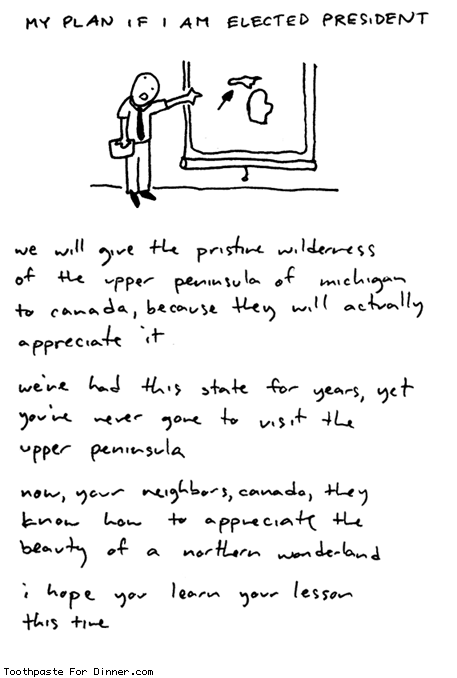
Within a year of living in Madison, Amanda and I had exhausted our two hiking guides of everything remotely interesting within 4 hours of a town that was, otherwise, a fantastic place to live. So we headed north to ‘the UP.[2]’ This was Amanda and my first backpacking trip together. It would take more for us to learn to do it together well. But this is Midwest hiking at its best. The first day was a spectacular coastal hike along the boundary waters of Lake Superior.
The second day jutted inland following the river and climbing a number of dramatic water falls.
The final day ended with views of Porcupine mountain, the highest point in the quad state region…at ~2,800 ft. Lets just say that Midwest hiking is not about elevation.
This, of course, sets up this brilliant comic by ‘Toothpaste for Dinner’:
#13 Avalanche Pass to Colden/Algonquin (1 to 3 days, 18 to 22 miles)
Adirondack Park is the largest state park in the lower 48. They are also my ‘home mountains.’[3] This is where I fell in love with the air, the burn, the views, the miles, the solitude, the adventure, and the wonder the unmitigated brunt of creation. As a kid we made occasional outings but it was not until college, when I went backpacking with the Geneseo outing club and led wilderness trips in the summer that they became very familiar. Western hikers chuckle when I talk about the 46 peaks between 4,000 and 5,200 feet that New Englanders ‘collect’…or the long wooded hikes that only grudgingly relinquish their views in the final 100m. But there is still something magical about them. The ‘Daks are over a billion years old (some of the oldest rocks in the lower 48) and are such a good example of anorthosite, that the rare metamorphic often takes their name.[4] There is no equivalent to crossing a stream lined with the enormous, dramatic clasts of metamorphosed feldspar that glint rainbow sheens through the shallow flows.[5]
I took the famous trail through avalanche pass. Avalanche pass follows Avalanche Lake between mount Colden and Mount Algonquin. The novel thing about this ‘pass’ is that there are places where the lake fills the entire span between the granite cliffs, requiring special constructed bridges built into the side of Algonquin.
(Note: I got this picture off the web...it is not from our trip.)
This was before I believed in tents[6] and was visited that night by a fox. The next day I went up the back side of Colden[7]. It seemed surprisingly difficult and I shook my head at how out of shape I was. When I reached the peak I was greeted with apparent surprise of a group of middle aged men. One of them was a guide who articulated their interest. “You came up the back side of Colden in full pack. That’s impressive, man.” It was a vindicating moment.
I have since learned the back sides of Colton and Algonquin are ‘affectionately’ nicknamed[8] “Three miles straight up.” A couple years later, Amanda and I did Algonquin (the second highest of the ‘Daks) back side trail, as a day hike, in knee deep snow. Let’s just say, she is not that happy with me in this picture. But it was still a fantastic day.[9]
#14 Notch Mountain: Rocky Mountains CO (1 day: 10 miles)
I had always suspected I wanted to live in the west…this was the day I knew it. I was in Denver on business and I stayed for the weekend, rented a car, and picked a couple mountains to climb. The fist night I went to a Colorado Rockies game before I headed out, so I arrived at the camp site in Vail after 11pm. It was full. So I drove the little rented Neon over the dark, washboard, dirt road for miles and napped in the car at the trail head. I was up and on the trail by 5. The first mile or so was familiar, a lovely wooded trail. But then something totally unfamiliar happened. I crossed the tree line near the beginning of the hike[10], giving me wide open views of vast alpine meadows and neighboring peaks for the vast majority of the hike.
I was the first one on the trail so I saw all the Marmots and Pikas (merely mythical creatures of 3rd grade science reports to that point) I could ever want to. The summit yielded a gorgeous view of the famous Mount of the Holy Cross.[11] It was a beautiful day.
The next day I climbed Mt Massive.[12] This was a much more challenging climb and I got altitude sickness (the only time I ever have) and badly burned. But these were minor costs. It was even more dramatic than Notch. I was hooked. We were eventually headed west.
Honorable mention:
Macomb Mountain – I climbed the slide of this un-trailed Adirondack Peak with the Geneseo outing club[13]. It was October and you could see Vermont and a sea of peak, north eastern, deciduous color. We climbed two more peaks that day and then got lost, spending the night[14] by a river and a huge bonfire.[15]
Dinosaur National Park – On our first vacation together ever, we took this short evening hike along the green river, with great Uinta monoliths in the background. The trip to Dinosaur was far more about fossils than hiking. But we mainly went because I wrote a 50 page paper in undergrad on the geomorphology of this part of the park. I literally labeled and described the geologic history of each stream (there must have been about 300) within several square miles of the place where Amanda stands in the picture. Ah, the scientific education.
Rocky Mountain National Park – This was our first excursion to western peaks (same trip as Dinosaur above). It was a vacation to celebrate finishing my Wisconsin Masters degree. We did not realize how late western peaks stay snowed over so our hikes were difficult. We climbed flat top mountain in the snow and Amanda got a second degree sunburn. But the surrounding peaks were unlike anything we had ever seen[16] and when we woke up one our tent was surrounded by elk. I’m sure I remember it as more fun than it was, but I remember it as really fun.
Olympic ridge – One day 18 mile loop into the heart of Olympic National Park with spectacular views of Mt Olympus. We slept at the trailhead and hiked hard, but the ridge yielded views of the central peak for several miles.
Dix Mountain – Amanda and I climbed this peak in the fog. There was no view. It is the only peak I have climbed twice by different routes.[17] But we had a great day together. What could otherwise be considered a sub-par day on the mountain is one of my favorite days I have spent with my wife.
Lake Louise/Lake Agnes – The Canadian Rockies are seriously underrated. Canadian trails are more like European trails in that they have periodic ‘tea houses’ where you can stop for a snack and some tea. In a 16 mile day hike we encountered two of them. I have mixed feelings on these. They are really nice for breaks, but mitigate the wilderness feel. Tea houses aside, however, the Canadian Rockies are 100% worth the trip. The only reason they did not crack the top 14 is because the trail guides tend to be unhelpful and I did not make good selections.
LeConte Mountain - Speaking of Wilderness architecture, we were invited to the wedding when a guy Amanda dated in high school was getting married just outside of the Smokey Mountains, shortly after we moved to Buffalo. I thought it sounded fun but also pitched a few hiking days as part of the trip. The highlight was climbing[18] LaConte Mountain. We found great views, but we also fund a cabin village and a lodge serving gourmet meals.
The Final pre-Kids trip in the West Sierra – 3 days, Gorgeous peaks, expansive lakes, a pace that covered ground but was healthy for marital harmony. Before I moved to CA this would have been 3 of the best days of my life. Now it makes honorable mention. That’s a good thing.
Point Rays ‘Manpacking’ – 3 days, 21 Miles. This was, actually, only a couple months ago. I started preaching at College Life, our church’s on campus college ministry. 8 guys planned[19] a spring break backpacking trip in Point Reyes national park.[20] Amanda gave me the green light and I had a blast getting to know the guys and hiking some of the most dramatic coastal trails in northern California.
This post was prepared while listening to A Beautiful Lie by 30 Seconds to Mars
___________________________ [1] As if this blog wasn’t topically eclectic enough. [2] Michigan’s upper peninsula. One of the enjoyable subplots of living in the Midwest was meeting someone from Michigan and asking them where they lived. They would put up their right hand like a mitten, representing the southern land mass of their state…and point. This became particularly hilarious when they lived in the UP because representing the whole state left them without appendages to point, and they would sometimes involve their nose in an elaborate way of conveying precise information of limited value. [3] Every hiker has ‘home’ mountains. And while the Sierra has long since surpassed the Adirondacks as the mountains I know the best and am most comfortable in, the ‘daks will always be where I learned the skills and made mistakes and got hooked. [4] E.g. adirondak anorthosite [5] In undergrad, the guys who had jobs in the geology thin section lab, would use the rock saws to make gifts (like book ends) out of finished blocks of anorthosite. [6] I used to believe that you should save the weight of a tent by just bringing a small tarp and a bug net. [7] Coldon is nestled between the ‘daks two highest peaks, Marcy and Algonquin. To date, it is my favorite view (apart from the October summit of Malcolm that had more to do with foliage than rock – see Honorable Mention). It reminds me of that shot in the Lord of The Rings where you can make out Isengard and the Great Eye of Mordor ominously dominating the landscape. [8] By my friend Brian Chapman. [9] My friend Brian and I have considered writing a book called something like, ‘How to Take Your New Wife Hiking.’ Almost every guy I have ever talked to who has tried to introduce their girlfriend/wife to their passion for peaks and miles, made the exact same mistakes of too much too early. [10] Up to that point I had only experienced the ‘Daks, where the only view was at the very peak. This was like an enthusiastic recreational pot user suddenly shooting heroin into his eye balls. [11] So named because the geologic formation that retains snow in perpendicular cracks well after it has melted elsewhere, leaving the stark mountainside emblazoned with a cross for much of the hiking season (though it was mostly faded by the time I got there). [12] The second highest mountain in Colorado by like 14 ft…actually, before the USGS updated the datum a couple decades ago, it was considered the highest. [13] When the guy in charge of lunch busted it out it consisted of a block of cheese, a hunk of salami, and a huge chocolate bar. This became my tradition...until the enobling influence of marriage. [14] Again, this was Columbus day weekend, so it was literally freezing (our water bottles formed ice). But I was lost with another geophysicist and a geochemist. We had all TA’d intro geology. Topos were second nature and we did just fine. There was a funny moment from that night worth relating. After it was clear we were lost in the dark with limited flashlight time I said to the other two guys (who were pretty good friends) ‘You know guys, when I get in situations like this, I like to pray’ (suggesting I take a moment to do so – Ah, more passionate and annoying days). Dave the geochemist responded ‘Do you get in situations like this a lot?’ This was also the trip in which I became a pants convert. Up to this point I did not believe in pants…hiking only and always in shorts. Lets just say…I now believe in pants. [15] Oddly, there were three pictures from this weekend in the Geneseo yearbook (one of the photographers was on the trip). I only know this because my Mom secretly bought one. [16] Amanda commented that it was like someone was doing a CGI feed for our vacation. [17] I climbed the slide with the outing club in undergrad. [18] We did not originally intend to climb the mountain. I was just going to be an easy hike to a big waterfall. But it was Fall and the waterfall had dried up, so we missed it and kept going. It was a beautiful day and a great outing, so we just kept going and before we knew we had climbed the mountain. [19] This is one of my favorite differences between college ministry and youth ministry. I literally just packed my stuff and showed up. They had planned everything. [20] A peninsula on the pacific coast literally formed by the San Andreas fault shearing part of California off into the ocean.


 It appears that over the course of the year, posts have gotten less frequent and longer. I am not happy with that trend. Long posts are tedious to read and quiet blogs are read less. So one corrective I would like to make is to not be afraid of actual blog posts. At this point, almost everything I am putting up here is essay length. I would like to post more 300-1000 word idea entries (my footnotes are currently approaching that on their own). The ‘Fragments’ posts have become bloated. There were at least 2 things in the last one that should have been their own posts.


 The second day jutted inland following the river and climbing a number of dramatic water falls.
 The final day ended with views of Porcupine mountain, the highest point in the quad state region…at ~2,800 ft. Lets just say that Midwest hiking is not about elevation.


 (Note: I got this picture off the web...it is not from our trip.)
 I have since learned the back sides of Colton and Algonquin are ‘affectionately’ nicknamed
 I was the first one on the trail so I saw all the Marmots and Pikas (merely mythical creatures of 3rd grade science reports to that point) I could ever want to. The summit yielded a gorgeous view of the famous Mount of the Holy Cross.
 The next day I climbed Mt Massive.