Showing posts with label marriage. Show all posts

Sunday, February 15, 2015

A Two Front Strategy: Aspiration and Contentment in Love and Vocation


I recently gave two talks on work.   

The first argued that our culture underrates vocation, the second argued that canonical clichés put too much hope in our careers and dreams.

So what’s true?  Is work too important or not important enough?

Well, yes.[1] 

Some days we vest our work with too much meaning, giving it power over us. Other days we despair at the basic meaninglessness or bureaucratic frustrations that surround it.

Life happens in the tension of aspiration and contentment. 

Overrating aspiration[2] creates disappointment and bitterness.

Overrating contentment creates regret and…well…bitterness.[3]

Thesis: Aspiration and contentment aren’t competitive entities.  They aren’t zero-sum enemies.  They are both necessary components of spiritual and psychological sustainability in our world and economy. 

Here’s how I think it works in Love and Vocation (spoiler alert, they are parallel):

Love

Love starts easy, requiring neither the hard work of aspiration nor the hard work of contentment. 

The magnitude of the lover’s passion and the loveliness of the loved fills the gap between them.  Passion of the lover meets the perceived worthiness of the loved.  In other words, between the lover and the loved (and visa versa) there is enough passion and attraction to fill the gap between them and everything is awesome:


 But, of course, it’s also an unsustainable lie.  None of us are as lovely as we appear at first.  We do not withstand scrutiny well.  And as everyone knows, after about 18 months, a crack begins to form between the sufficiency of passion and attraction, as both begin to wane a bit.  Then the full disclosure of marriage sets in, and the lovers find that the sum of passion and attraction are not sufficient to carry the day.  

 
Both sides require discipline.  In a real live partnership, a 100%/100% shared covenant, both respond with action.

The loved responds with aspiration, trying to become easier to love and the lover responds with contentment, learning to love the actual person they chose, not some romanticize projection of themselves they imagined in the sexually surcharged early days of their relationship. 
  

Those who stick to it, find real, live, sustainable, no-kidding, LOVE, as aspiration, turns into growth, new things to generate attraction and contentment manifests as grace, enoughness, extending love without condition.  And the sum of these, fill the gap.


And of course, an exactly symmetrical process mirrors this in healthy relationships.


Vocation

I had a professor once who said “Freud was wrong about almost everything, but he was wrong in really interesting ways.”  I think one of the things he was actually right about was the centrality of love and work to our overall well being.   

And the longer I do both, the more I find the skills required to thrive in them complementary.

When we start to explore a particular niche in the economy and world of mutual service, our future work seemed exciting.  It seemed to bubble with potential, and it is easy to generate passion about how work can affect our world.  Uncluttered by the boring details or soul deadening bureaucracies, it seemed that some combination of our passion and our job’s interestingness should carry the day. 


But you don’t have to work very long to get disillusioned with this.  Soon a gap of dissatisfaction opens between your passion for the work and the work’s worthiness.


This requires the same, two-front strategy as love. 


You aspire.  Aspiration can go to work on the ‘interestingness’ of your job, tooling up with new skills, qualifying yourself for new projects, earning trust in small tasks to open the door to bigger, more interesting tasks, and (in the biggest difference between love and work) getting a new job.  

But Contentment fills the gap, active disciplines of enoughness fills the gap between you and your job with joy and gratitude and the privilege to work, to bring order out of chaos, to participate in the image of God as a co-maker, as a collaborating artist. 

This post was written while listening to the Beautiful Eulogy[4] Pandora Station.


[1] This is the biggest challenge of preaching. (Or blogging, which I’ve decided is essentially the new preaching…except for TED talks, which are actually preaching without trying to pretend they are something else.) Most theology and reality is in tension, and our traumas come from over-emphasizing one side of the tension or the other.  But in any given room, or sub culture, or ‘readership,’ there are some who need to move one way and some who have to move the other.  And for most of us, we inflict both traumas on ourselves at various times.  So you can almost never say, “the problem is.”  It is usually “the problem is cross pressured by these two contrasting distortions."
[2] This was the basic motivation of my second talk.  Overrating aspiration is one of the reasons young adults find the 20s so depressing. 
[3] There are two kinds of bitter old people, those who gave it everything, and came up short, and those who wish they’d tried harder.
[4] More on this later…but while I was busy dismissing it as an indistinc prong of the CCM industry for the last decade or so, Christian rap got shockingly good.  Christian rap isn’t just a sub-genre of Christian music…it’s something totally different. 

Tuesday, January 17, 2012

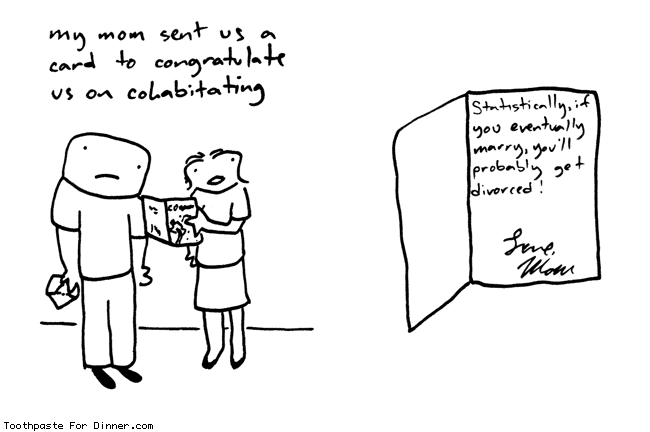
Romance (Part 3): A comic interlude (random comics and clips)

A lot of good speakers/preachers keep topical illustration and content files.  I have found that too complicated.  I have a single, huge, comics and illustration file.  At the beginning of each quarter I brouse it to see if there is anything useful for my upcoming talks.  It turns out that in the last few years I have collected more material on romance and relationships than any other single topic.  So I gave it its own folder.[1]  I chose a handful for the talk…and decided to put a few more up here.  Sources include NatileeDee, toothpastefordinner, xkcd, youtube, saturday morning breakfast cereal and a couple others I have forgotten.


Note: This one is not only hilarious but also really insightful.


For some reason this one reminds me of the presidential debate last night.


[1] Second place, it turns out, is existential dread.  Apparently sex and oblivion are either particularly funny or are topics I really resonate with.  So I have created two topical sub-folders and I’ll do a post like this in a couple months that highlights the comedic material from the second one.


Tuesday, January 10, 2012

Relationships (Part 1) - The Myth of 25: Divorce, Age of First Marriage and the Importance of Inflection Points

Note: Tonight we start a three part series on relationships at CollegeLife, the campus ministry our family is involved with. The topics will be friendship, family, and romance. I drew the short straw and will be doing the romance talk two weeks from today. We structured the series this way because my thesis is that romance is the mechanism to turn a friendship into a family (which is the smallest unit of missional community). Unsurprisingly, I have a number of thoughts that emerge from my study and reflection on this over the last couple months that won’t even make it into the manuscript I cut. So I’m putting them here.

I have heard and read several times in my preparation for this relationship talk that “the probability of divorce is significantly higher for couples that get married before 25 than those that get married after.” This is true. Unfortunately, it also fails to convey the important information. You see, it is also true that there is a lower divorce rate for those who get married before 75 than for those who marry after…but this statement also fails to not convey the useful information. The question is not ‘how do the statistics line up on either side of an arbitrary boundary that I chose for polemical purposes?’ but ‘what is the inflection point of this monotonic function?’

Here are the actual statistics that everyone is quoting. [1][2]


The “under 25” stats are dragged down by the 15-20 stats. The meaningful inflection point is at 20. [3] Which means that for the question most college students are asking: “is it wise to peruse a relationship that might turn into marriage right after college” (say at age 22). [4] The answer is ‘sure’. Who you are [5] is more important than when you marry after the important inflection point of 20. [6]

Now for the speculative part. Why is there no significant difference between the early 20’s and late 20’s when so much social and human development happens in that decade? Well, you will be shocked to learn that I have a theory. Those who get married older presumably have more maturity [7] (e.g. self skepticism, experience with communication, the ability to budget, etc…) which will certainly help a marriage. But maturity is a trade off with another marriage asset…flexibility. [8]

I think getting married at 28 is fine and has a number of non-trivial advantages. But the same can be said of getting married at 22 (which is what Amanda and I did). I am not the person she married. But she was there for the process of becoming (and had the opportunity to influence it and be influenced by it) giving us a shared story and convergent behaviors. Our adult lives have been lived together before we formed divergent habits.

So, the answer to the question, ‘is there a higher divorce rate for those who marry before 25?’ is, yes. But it doesn’t answer the real question college students are asking.

The more important question to most college students: “Is there a statistically significant higher divorce rate for 22 year olds than 28 year olds?” returns the null hypothesis.

This post was written while listening to the Charlie Darwin [9] station on Pandora
____________________________
[1] Bramlett MD and Mosher WD. Cohabitation, Marriage, Divorce, and Remarriage in the United States. National Center for Health Statistics. Vital Health Stat 23(22). 2002.
[2]The study also showed that the probability of a ‘cohabitation disruption’ drops from 67% to 53% from the 20-24 to the 25 and over age classes. But this is a fundamentally different phenomenon as the study also showed that couples that cohabitate before marriage have a higher divorce rate (cohabitation – 51% divorced after 15 years compared to non-cohabitators 39%). Bramlett MD and Mosher WD. Cohabitation, Marriage, Divorce, and Remarriage in the United States. National Center for Health Statistics. Vital Health Stat 23(22). 2002. Which led to this:
[3] And, I would argue, that the selection of 25 as an arbitrary threshold is often intentionally deceptive. The cultural narrative that marriage unnecessarily restricts freedom has worked its way into the public consciousness in a way that is not fundamentally questioned.
[4] Note, this is a non-linear function, so if the inflection point is at 20, we can probably expect that 20-22 behaves more like the previous time series than 22-25, making 22 statistically identical to 28. But given the sample size, it is safe to say that 22 is not ‘significantly’ different than 28, in a statistical sense.
[5] And, as the study suggests, the baggage you bring to the marriage from your family and community…and also your income (which is a whole other post).
[6]Note: this is for “all races” but Bramlett and Mosher thought one of their most interesting findings was how the Latino community diverged from this result. There was no real trend. The 20-24 cohort had the lowest divorce rage followed by the <18 cohort, but all were within a few percentage points of each other.
[7] If they embrace the process of actively converting experience into wisdom. Age is correlated with wisdom, but not predictive. Age is not an automatic vehicle of wisdom. We have to actively harvest wisdom from the fields of our joy and pain.
[8] It is interesting that the numbers are identical after 15 years but don’t take the same path to get there. 5 years out, marriages between older partners take the lead (i.e. fewer ‘disruptions’). Which means that the statistics show that if an early marriage survives the first 5 years, it has a higher chance of making it than an older marriage that survives the first five years. I might argue that a lack of maturity will blow up on the front end…but if you survive it, the flexibility gains are substantial.
[9] By Low Anthem.

Sunday, January 3, 2010

Our Brain’s Surprising Mistake: Freedom, Prediction and Marriage

There may not be a more intensely American value than Freedom. It is one of the few things seen by almost all as an unqualified good. The last administration used it as a trump card in support of foreign wars and domestic tax cuts. The current administration has followed suit, leveraging[1] our passion for freedom on behalf of their pursuits. In a world where we can not remotely agree on what is good, valuable or beautiful, the thing we fight most intensely for is self determination of those criteria. Many of fiction and history’s most compelling figures were revolutionary agents for their self determination. Shoot, the climatic moment of one of the best movies ever simply consists of the disemboweled protagonist yelling ‘FREEDOM.’


In our country’s founding document Freedom is listed as one of the foundational, self evident, divinely granted human rights…along side ‘The Pursuit of Happiness.’ We have since generally assumed that freedom and happiness are strongly correlated. But this is an assumption that is worth revisiting. Surely, slavery, communism and fascism impinge on personal happiness…but within the context of most western societies, does increased freedom actually increase happiness?

Daniel Gilbert, the Harvard College Professor of Psychology[2] says no.

In his excellent book Stumbling on Happiness[3] he cites a study in which students in a photography class produced a dozen black and white photographs and printed their two best and were allowed to keep one. The students were divided into two groups, 1) the escapable group and 2) the inescapable group. The first group could exchange their photograph for the other one at any time in the future and the second group had to make a final, irrevocable decision on which photograph they would keep. Then the researchers followed up on the students and ‘measured’[4] their satisfaction with the photographs. Which do you suppose were more satisfied? If our fundamental assumptions that self determination and increased options produce happiness are true, then we would expect the first group to be the most satisfied.[5] But the opposite was true.

“The escapable group liked their photographs less(emphasis original) than the inescapable group…Apparently, inescapable circumstances trigger the psychological defenses that enable us to achieve positive views of those circumstances, but we do not anticipate this will happen. Our failure to anticipate that inescapability will trigger our psychological immune system (hence promote our happiness and satisfaction) can cause us to make
some painful mistakes…but most people seem to prefer more freedom to less…


...Our fetish for freedom leads us to patronize expensive department stores that allow us to return merchandise rather than attend auctions that don’t, to lease cars at a dramatic markup rather than buying them at a bargain, and so on…


...Committed owners attend to a car’s virtues and overlook its flaws, thus cooking the facts to produce a banquet of satisfaction, but the buyer for whom escape is still possible is likely to evaluate the new car more critically, paying special attention to its imperfections as she tries to decide whether to keep it…We have no trouble anticipating the advantages that freedom may provide, but we seem blind to the joys it can undermine.”[6]


And this, in part, is why I believe marriage[7] is vastly underrated. Marriage is not exactly at the peak of its popularity, particularly among young men.[8] I believe that one of the fundamental reasons for marriage’s disrepute is this perception that limiting our freedom is the surest way to limit our happiness. It is ironic[9] that such a widely held tenet of our cultural narrative is based on a nearly universal misunderstanding of how our brains work.

But marriage only works if it is an ‘all in’ proposal. ‘For better or worse’ is the currency of marital satisfaction. It is the engine of contentment. According to Gilbert, inescapability is the catalyst of disproportionate focus on the admirable aspects of your selection. It is an unconscious building block of a life of gratitude. Our brains are wired in such a way that frequent re-evaluation undermines our happiness.

The volitional and intentional limitation of options is a counterintuitive path to happiness. In his theological work on marriage, Christopher Ash, argues that this is because marriage is the way of grace over works:

“When we focus on the gradually deepening (or evaporating) relational intimacy as the locus of marriage, paradoxically a terrible insecurity is engendered…To live outside is to live by works, to be constantly on our best behavior, to be only as good as the last time. To live inside (the covenant of marriage) is to live in grace, responding freely to unconditional pledged love, not to have failure and personal inadequacies drive us to paralyzing despair.”[10]

It is only when marriage is seen for what it truly was meant to be, that the Scriptures’ repeated comparison of marriage and the gospel begin to make sense. And, of course, the principal that limiting one’s freedom can actually augment one’s happiness has spiritual implications beyond marriage. A common objection to Christianity is that it limits our freedom and, thus, our potential for happiness. But, deconstructing the fundamental connection between freedom and happiness destabilizes this objection.

I think the Psalmist essentially articulates the same thing Gilbert reports when he says: “Yahweh, you have assigned me my portion and my cup; you have made my lot secure. The boundary lines have fallen for me in pleasant places.”[11]

This post was written while listening to the Rise Against station on Pandora

_____________
[1] Or manipulating our passion for freedom, depending on one’s political perspective.
[2] At Harvard University.
[3] This is not nearly the saccharine self help book it sounds like. Rather, it is a well written and insightful review of recent psychological research on the phenomena of human happiness and why our brains are not particularly good at it (or, conversely, why we are sometimes better at it than the ‘facts’ warrant).
[4] So, I am what is called a ‘hard’ scientist. I realize that moniker is self serving, but if you are skeptical about how this was ‘measured,’ um, well, me too.
[5] In fact, this was another facet of this study. Several of the students were asked to predict if they would be more satisfied if they had the option to exchange and most said they would.
[6] Daniel Gilbert, Stumbling on Happiness – p 183-5
[7] In its covenantal, vowish, form rather than its dissoluble social contract form.
[8] Chuck Klosterman has a great quote in Killing Yourself to Live that really encapsulates the contemporary perception of marriage. He seems genuinely confused at the controversy in the Episcopal Church about same-sex marriage and quips “In my opinion we must legalize gay marriage. Gay men are the only men in America who still want to be married.”
[9] Again, ironic in the Alanis Morissette ‘as it has come to be know’ usage of the word.
[10] Marriage: Sex in the Service of God p 74-5
[11] Ps 16:5-6